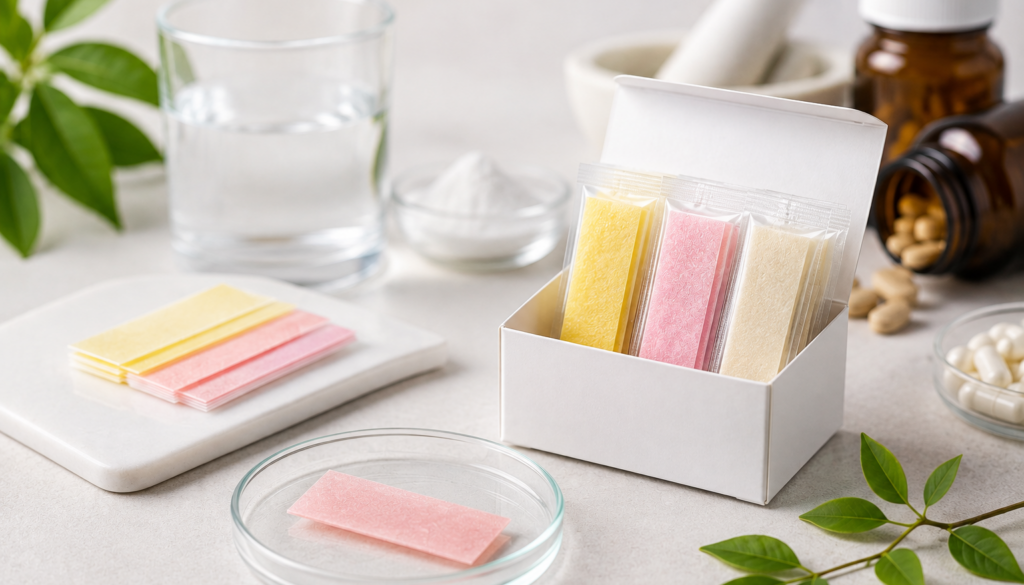
Nutraceutical Oral Strip Feasibility: 10 Critical Factors Before Product Development
Nutraceutical oral strip feasibility is one of the most important evaluations for brands planning to develop vitamins, minerals, botanical extracts or other functional ingredients in an oral dissolving film format. A promising ingredient does not automatically mean that it can be successfully converted into a thin, flexible and commercially manufacturable oral strip.
Ingredient loading, ingredient form, solubility, taste, mouthfeel, polymer compatibility, film dimensions, stability, packaging and manufacturing conditions can all influence whether a concept is practical.
A strong nutraceutical oral strip feasibility assessment helps identify these challenges before significant development investment is made. It can also help brands avoid costly formulation mistakes, unrealistic dosage expectations and unnecessary delays.
What Is Nutraceutical Oral Strip Feasibility?
Nutraceutical oral strip feasibility is the technical assessment used to determine whether a proposed nutraceutical formulation can realistically be developed and manufactured as an oral film.
The evaluation may consider:
- Functional ingredient
- Ingredient form
- Target amount per film
- Number of ingredients
- Solubility or dispersibility
- Taste
- Mouthfeel
- Polymer compatibility
- Film dimensions
- Mechanical properties
- Disintegration
- Manufacturing behaviour
- Stability
- Packaging
- Destination market
The objective is not simply to determine whether an ingredient can be added to a film.
The objective is to determine whether the complete formulation can become a practical product with appropriate physical, sensory, manufacturing and stability characteristics.
Nutraceutical Oral Strip Feasibility at a Glance
| Feasibility Factor | Key Question | Potential Risk |
|---|---|---|
| Ingredient Loading | Can the target amount fit in the film? | Excessive thickness |
| Ingredient Form | Is the selected form suitable? | Poor processing |
| Solubility | Can the ingredient dissolve or disperse? | Non-uniformity |
| Taste | Is the sensory profile manageable? | Poor acceptability |
| Polymer Compatibility | Can a suitable film system be created? | Weak or brittle film |
| Film Dimensions | Is the required size practical? | Poor user experience |
| Disintegration | Does the film perform as intended? | Slow or inconsistent behaviour |
| Manufacturing | Can the formula be scaled? | Commercial failure |
| Stability | Does the product remain acceptable? | Degradation |
| Packaging | Can the film be adequately protected? | Moisture or oxygen exposure |
1. Start With the Exact Ingredient Form
The first step in nutraceutical oral strip feasibility is defining exactly what ingredient will be used.
An ingredient name alone may not be sufficient.
Important details may include:
- Chemical form
- Salt form
- Grade
- Purity
- Particle characteristics
- Botanical extract ratio
- Carrier system
- Supplier
- Specification
For example, two materials marketed under a similar ingredient name may behave differently during oral-film development.
Differences can potentially affect:
- Solubility
- Taste
- Viscosity
- Colour
- Mouthfeel
- Stability
- Manufacturing
This is why ingredient identity should be confirmed before meaningful feasibility conclusions are made.
2. Define the Target Amount Per Film
The next critical question is:
How much of the ingredient is required in each film?
This is one of the most important parts of nutraceutical oral strip feasibility.
A thin film has limited physical space.
Higher ingredient loading can potentially increase:
- Film thickness
- Total solids
- Brittleness
- Grittiness
- Taste intensity
- Drying requirements
It can also potentially reduce:
- Flexibility
- Processability
- Consumer acceptability
A formulation that appears feasible at a low loading may become difficult when the required amount increases significantly.
A Costly Mistake to Avoid
One of the biggest mistakes is asking whether an ingredient “can be made as an oral strip” without specifying the target amount.
The technically useful question is:
Can this exact ingredient form, at this target amount per film, be incorporated into an acceptable oral-film formulation?
That provides a much stronger starting point.
3. Evaluate Total Ingredient Loading
Many nutraceutical concepts contain multiple functional ingredients.
For example, a brand may want:
- Vitamin A
- Vitamin B
- Vitamin C
- Mineral
- Botanical extract
- Additional functional ingredient
Each ingredient may appear manageable individually.
However, the complete formulation has to fit within one film.
Total loading can influence:
- Film size
- Thickness
- Mechanical strength
- Taste
- Mouthfeel
- Disintegration
- Casting
- Drying
Therefore, nutraceutical oral strip feasibility should evaluate the complete formula rather than assessing each ingredient in isolation.
4. Solubility and Dispersibility Matter
Not every nutraceutical ingredient behaves the same way in the liquid system used to manufacture oral films.
Some ingredients may dissolve readily.
Others may remain dispersed.
This difference can influence:
- Mixing
- Viscosity
- Sedimentation
- Casting
- Content uniformity
- Appearance
- Mouthfeel
If particles remain within the film, particle characteristics may also become important.
A dangerous assumption is believing that every ingredient must completely dissolve for an oral film to be possible.
The appropriate formulation strategy depends on the ingredient and intended product.
However, the developer needs to understand how the material behaves before establishing the process.
5. Taste Can Determine Product Feasibility
Taste is a major challenge for many nutraceutical ingredients.
Potential sensory characteristics include:
- Bitterness
- Metallic notes
- Sourness
- Astringency
- Herbal notes
- Strong aroma
- Persistent aftertaste
Because oral films hydrate directly in the mouth, unpleasant ingredient characteristics may become noticeable quickly.
A nutraceutical oral strip feasibility assessment should therefore consider taste early rather than waiting until the final prototype.
More Flavour Is Not Always the Solution
Simply increasing flavour concentration may not adequately manage difficult sensory characteristics.
Taste-masking development may need to consider:
- Ingredient form
- Sweeteners
- Flavours
- Sensory modifiers
- Aroma
- Mouthfeel
- Ingredient loading
- Disintegration behaviour
Taste should be evaluated as part of the complete formulation system.
6. Mouthfeel Is Just as Important as Taste
A product may have an acceptable flavour but still provide a poor consumer experience because of mouthfeel.
Potential issues include:
- Grittiness
- Roughness
- Excessive thickness
- Stickiness
- Residue
- Unpleasant coating sensation
These problems can become particularly relevant when a formulation contains high levels of dispersed material.
For this reason, nutraceutical oral strip feasibility should evaluate both taste and physical sensation in the mouth.
7. Polymer Compatibility Is Critical
Film-forming polymers provide the structural foundation of the oral strip.
The polymer system needs to work with the active or functional ingredients and other excipients.
A successful formulation generally needs appropriate:
- Film formation
- Flexibility
- Strength
- Handling
- Disintegration
- Mouthfeel
Functional ingredients can potentially influence polymer behaviour.
For example, increasing ingredient loading may change:
- Viscosity
- Film structure
- Drying behaviour
- Mechanical properties
Therefore, a polymer system should be selected based on the actual formulation rather than using one universal solution for every nutraceutical product.
8. Film Size and Thickness Must Remain Practical
A common response to high ingredient loading is to increase the size or thickness of the film.
However, this can create new challenges.
An excessively large or thick film may affect:
- Consumer experience
- Mouthfeel
- Hydration
- Disintegration
- Packaging
- Manufacturing
The product-development team therefore needs to balance ingredient loading with practical film dimensions.
This is a central part of nutraceutical oral strip feasibility.
9. Disintegration Should Match the Product Objective
The intended behaviour of the film should be defined early.
Depending on the product concept, developers may consider:
- Placement in the mouth
- Hydration behaviour
- Disintegration characteristics
- Ingredient exposure
- Sensory experience
Disintegration can be influenced by:
- Polymer
- Film thickness
- Ingredient loading
- Moisture
- Formulation composition
A high-loading formulation that creates an excessively thick film may behave differently from the original product concept.
Therefore, physical performance and ingredient loading should be evaluated together.
10. Manufacturing and Scale-Up Must Be Feasible
A prototype that looks good in the laboratory is not automatically a commercially feasible product.
Commercial manufacturing introduces additional considerations.
These may include:
- Batch size
- Mixing geometry
- Viscosity
- Deaeration
- Liquid hold time
- Casting
- Drying
- Web handling
- Cutting
- Packaging
A robust nutraceutical oral strip feasibility programme should consider whether the formulation can progress beyond a small prototype.
Commercial feasibility is ultimately about reproducibility, not just producing one successful film.
How Ingredient Loading Affects Oral Film Development
| Increasing Ingredient Loading May Increase | Increasing Ingredient Loading May Challenge |
|---|---|
| Total Solids | Flexibility |
| Film Thickness | Mechanical Strength |
| Taste Intensity | Mouthfeel |
| Drying Requirement | Disintegration |
| Formulation Complexity | Casting |
| Raw-Material Cost | Uniformity |
The relationship is formulation-specific.
There is no universal loading limit that applies to every ingredient and every oral film.
Nutraceutical Ingredients and Feasibility Considerations
Different ingredient categories can introduce different development challenges.
Vitamins
Potential considerations can include:
- Target amount
- Taste
- Solubility
- Stability
- Light sensitivity
- Moisture sensitivity
Minerals
Some mineral ingredients may create challenges involving:
- Loading
- Taste
- Mouthfeel
- Particle characteristics
Botanical Extracts
Botanical materials may require consideration of:
- Extract ratio
- Carrier
- Taste
- Colour
- Aroma
- Particle characteristics
- Batch variability
Other Functional Ingredients
Other nutraceutical ingredients should be assessed according to their individual:
- Chemical characteristics
- Physical properties
- Loading
- Sensory profile
- Stability
The ingredient category alone cannot determine feasibility.
Single-Ingredient vs Multi-Ingredient Oral Strips
A single-ingredient product can sometimes provide a more straightforward feasibility assessment because fewer active or functional components need to be accommodated.
Multi-ingredient products can introduce additional complexity.
Potential challenges include:
- Higher total loading
- Ingredient interactions
- More difficult taste masking
- Analytical complexity
- Stability interactions
- Larger film dimensions
This does not mean multi-ingredient oral films are automatically impossible.
It means they require appropriate technical evaluation.
Why Nutraceutical Oral Strip Feasibility Should Come Before Pricing
Brands sometimes request a commercial unit price before the technical concept has been established.
This can create misleading cost expectations.
Manufacturing cost may depend on:
- Final formulation
- Ingredient loading
- Development scope
- Testing
- Packaging
- Batch size
If the formula changes significantly after feasibility work, the commercial assumptions may also change.
A better sequence is:
Concept → Feasibility → Development Scope → Packaging → Commercial Assumptions → Pricing
This can produce a more realistic commercial discussion.
Nutraceutical Oral Strip Feasibility and Packaging
Packaging is another important feasibility consideration.
Oral films may be sensitive to:
- Moisture
- Oxygen
- Light
- Temperature
The formulation can influence how much protection is required.
For example, certain functional ingredients may introduce additional sensitivity.
Packaging evaluation may therefore consider:
- Barrier properties
- Seal integrity
- Material compatibility
- Individual unit protection
- Storage
- Distribution
A technically promising formulation without suitable packaging may still face serious commercial challenges.
Stability Considerations
A successful fresh prototype is not enough to establish long-term product performance.
Stability evaluation may need to consider:
- Appearance
- Physical properties
- Ingredient content
- Degradation
- Disintegration
- Moisture
- Taste
- Aroma
- Packaging integrity
The exact stability strategy depends on the product and intended market.
A serious mistake is assuming shelf life based only on another oral-film product.
Each formulation should be evaluated appropriately.
Destination Market Should Be Defined Early
A product intended for one market may not automatically have the same classification, ingredient requirements, claims or documentation pathway in another.
Before significant development work begins, brands should define:
- Destination country
- Product category
- Proposed claims
- Target audience
These factors may influence ingredient selection and development strategy.
Manufacturing feasibility and market acceptability are related but separate considerations.
Nutraceutical Oral Strip Feasibility Scorecard
Brands can use a simple scorecard during early concept evaluation.
Score each category from 1 to 5.
| Feasibility Area | Score 1–5 |
|---|---|
| Ingredient Form Defined | |
| Target Amount Defined | |
| Total Loading Practical | |
| Solubility/Dispersion | |
| Taste Manageability | |
| Mouthfeel | |
| Polymer Compatibility | |
| Film Dimensions | |
| Manufacturing Potential | |
| Stability Potential | |
| Packaging Strategy | |
| Market Requirements Defined |
A lower score does not necessarily mean the product cannot be developed.
It can indicate where additional development work is required.
10 Costly Nutraceutical Oral Strip Feasibility Mistakes
1. Providing Only Ingredient Names
Exact ingredient forms and specifications matter.
2. Not Defining the Amount Per Film
Feasibility depends heavily on loading.
3. Evaluating Ingredients Individually
The complete formulation needs to fit within the film.
4. Ignoring Taste
Unpleasant sensory characteristics can become a major development problem.
5. Ignoring Mouthfeel
A gritty or excessively thick film may provide a poor consumer experience.
6. Assuming Every Ingredient Must Fully Dissolve
The appropriate approach depends on the formulation.
7. Ignoring Polymer Compatibility
Functional ingredients can influence film structure and processing.
8. Focusing Only on Laboratory Success
Commercial scale-up introduces additional variables.
9. Treating Packaging as an Afterthought
Environmental protection may be essential for maintaining product characteristics.
10. Assuming Shelf Life Without Evidence
Stability should be evaluated for the actual product and packaging.
Avoiding these costly mistakes can improve the efficiency of nutraceutical oral strip feasibility assessment.
Positive Signs That an Oral Strip Concept May Be Worth Developing
Positive indicators may include:
- Clearly defined ingredient form
- Realistic target loading
- Manageable total solids
- Acceptable sensory profile
- Practical film dimensions
- Suitable polymer options
- Manageable manufacturing behaviour
- Clear packaging strategy
- Defined destination market
- Realistic commercial expectations
These factors do not guarantee success, but they provide a strong foundation for structured development.
Serious Red Flags During Feasibility Assessment
Brands should be cautious if:
- Ingredient amount has not been defined
- Ingredient form is unknown
- Extremely high loading is expected in a very small film
- Taste is being ignored
- Packaging has not been considered
- The destination market is unknown
- Commercial pricing is requested before the product is defined
- Shelf life is assumed without evidence
- Scale-up is ignored
- A supplier guarantees every formulation is feasible immediately
These dangerous red flags can result in unnecessary development costs and delays.
Questions to Ask an Oral Strip Development Partner
When discussing nutraceutical oral strip feasibility, ask:
- Can you evaluate the target ingredient loading?
- Which ingredient specifications do you require?
- How do you assess solubility or dispersion?
- How is taste masking evaluated?
- How is mouthfeel assessed?
- How do you select the polymer system?
- How are film dimensions determined?
- How is disintegration evaluated?
- How is scale-up considered?
- Which analytical tests may be required?
- How is packaging selected?
- How is stability addressed?
- What information is needed before pricing?
- How are development changes documented?
- What determines commercial readiness?
Clear answers can help identify a more structured development partner.
How to Prepare a Nutraceutical Oral Strip Feasibility Brief
Before approaching a manufacturer, prepare:
Product Information
- Product category
- Destination market
- Intended audience
- Intended use
Ingredient Information
- Exact ingredient names
- Ingredient forms
- Supplier details where available
- Amount per film
- Required ingredients
- Optional ingredients
Sensory Requirements
- Preferred flavour
- Known bitterness
- Sweetness preference
- Mouthfeel expectations
Film Requirements
- Desired dimensions
- Disintegration objectives
- Packaging preferences
Commercial Information
- Launch quantity
- Annual forecast
- Target launch timing
Claims and Documentation
- Proposed claims
- Required documentation
- Existing technical data
Providing a decision-ready brief can make nutraceutical oral strip feasibility discussions more productive.
Frequently Asked Questions About Nutraceutical Oral Strip Feasibility
What is nutraceutical oral strip feasibility?
Nutraceutical oral strip feasibility is the technical evaluation of whether a proposed nutraceutical formulation can be developed into a practical oral-film product with suitable physical, sensory, manufacturing and stability characteristics.
Can any vitamin be made into an oral strip?
Feasibility depends on the specific ingredient form, target amount, formulation, taste, stability and other product requirements. It should be evaluated on a project-specific basis.
How much ingredient can an oral strip hold?
There is no universal loading limit that applies to every product. Practical loading depends on ingredient characteristics, film dimensions, polymer system and intended product performance.
Can multiple vitamins be combined in one oral film?
Potentially, but the complete formulation needs to be assessed for total loading, compatibility, taste, stability and manufacturing feasibility.
Why does ingredient form matter?
Different forms or grades may have different solubility, taste, particle characteristics, stability and processing behaviour.
Is taste masking important for nutraceutical oral strips?
Yes. Oral films interact directly with the mouth, so unpleasant ingredient taste or aftertaste can become an important development challenge.
Can a larger film solve high-loading problems?
Increasing film size may provide additional formulation space, but excessive size or thickness can affect mouthfeel, disintegration, packaging and consumer experience.
Why is packaging important?
Packaging can help protect the film from environmental factors such as moisture, oxygen and light depending on the product’s sensitivity.
When should commercial pricing be requested?
Pricing becomes more meaningful after key technical and commercial assumptions such as formula, loading, development scope, packaging and volume have been defined.
Does a successful prototype guarantee commercial manufacturing?
No. Commercial scale can introduce differences in mixing, casting, drying, web handling and packaging. Scale-up should be evaluated appropriately.
Build a Strong Nutraceutical Oral Strip Feasibility Strategy
A successful nutraceutical oral strip feasibility assessment starts with precise product information.
The exact ingredient form, target amount per film, total loading, sensory profile, polymer compatibility, film dimensions, manufacturing behaviour, packaging and stability requirements should all be evaluated as parts of one product system.
The best approach is to identify technical risks before making strong commercial commitments.
This can help brands avoid dangerous assumptions, reduce costly redevelopment and create a more reliable pathway from concept to commercial manufacturing.
Lagom Life Sciences reviews qualified nutraceutical oral-film projects across private-label, custom-development and contract-manufacturing pathways. Ingredient loading, formulation feasibility, taste masking, scale-up, packaging, stability and commercial supply should be confirmed through project-specific technical and quality review.
Ready to evaluate your nutraceutical oral-strip concept? Request a feasibility discussion with Lagom Life Sciences.