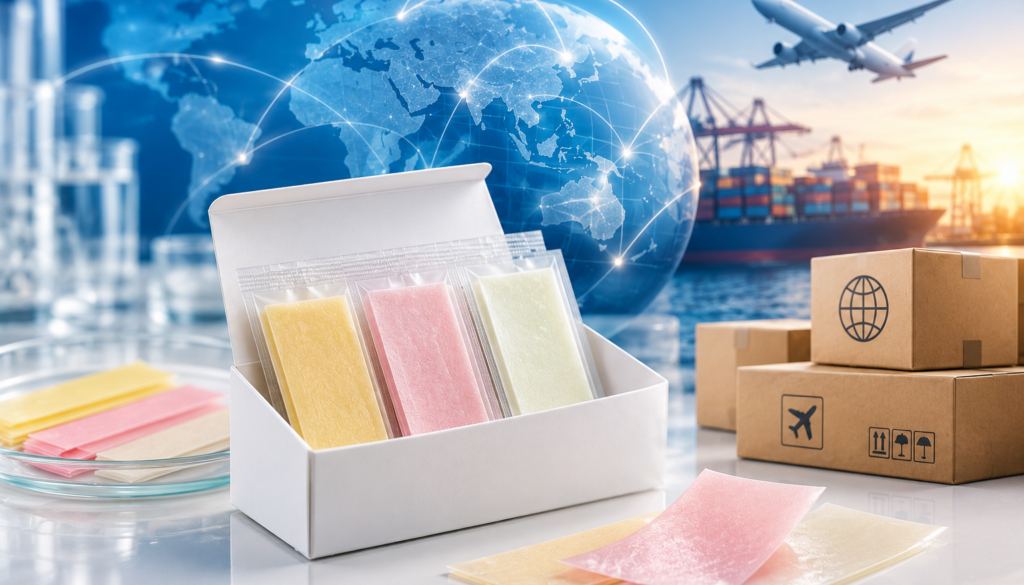
Global ODF Sourcing: A Complete Guide to Choosing the Right International Manufacturing Partner
Global ODF sourcing is an important consideration for pharmaceutical, nutraceutical, wellness and healthcare brands looking for specialised oral dissolving film development and manufacturing capabilities. Choosing an international ODF manufacturer involves much more than comparing prices or production capacity.
A successful global ODF sourcing strategy requires brands to evaluate technical expertise, formulation capability, quality systems, documentation, packaging, stability, minimum order quantities, commercial terms, logistics and long-term supply reliability.
The right manufacturing partner should fit the specific requirements of the product and destination market. A poor sourcing decision can result in costly delays, unexpected expenses, documentation gaps, quality concerns and serious supply problems.
This guide explains how brands can approach global ODF sourcing more effectively and identify a manufacturing partner capable of supporting development through commercial supply.
What Is Global ODF Sourcing?
Global ODF sourcing is the process of identifying, evaluating and selecting oral dissolving film manufacturers for international private-label, custom-development, technology-transfer or contract-manufacturing projects.
The sourcing process can involve:
- Manufacturer identification
- Technical qualification
- Formula assessment
- Quality review
- Documentation review
- Packaging evaluation
- Stability planning
- Commercial evaluation
- MOQ assessment
- Logistics planning
- Import and export coordination
- Long-term supply planning
The objective should not simply be to find the lowest-cost manufacturer.
The objective is to identify a reliable manufacturing partner whose capabilities match the technical, quality and commercial needs of the project.
Why Global ODF Sourcing Requires Careful Planning
Oral dissolving films are specialised dosage formats.
Their development and manufacturing can involve interconnected considerations such as:
- Ingredient characteristics
- Target amount per film
- Polymer system
- Taste masking
- Film strength
- Flexibility
- Disintegration
- Casting
- Drying
- Analytical testing
- Packaging
- Stability
When manufacturing is sourced internationally, additional factors such as documentation, freight, customs, importer responsibilities and destination-market requirements also become important.
For this reason, global ODF sourcing should begin with a structured project plan.
Start With a Clear Product Brief
Before approaching international ODF manufacturers, define the product as clearly as possible.
A useful sourcing brief should include:
Product Information
- Product category
- Destination market
- Intended use
- Target audience
- Proposed claims
Formula Information
- Ingredient names
- Exact ingredient forms
- Target amount per film
- Required ingredients
- Optional ingredients
Product Requirements
- Film dimensions
- Preferred flavour
- Mouthfeel expectations
- Disintegration objectives
- Packaging preferences
Commercial Information
- Initial order quantity
- Annual forecast
- Target launch timing
- Delivery destination
A detailed brief allows manufacturers to provide more meaningful technical and commercial feedback.
Evaluate Technical Manufacturing Capability
One of the most important parts of global ODF sourcing is evaluating whether the manufacturer actually fits the product.
Potential capabilities to assess include:
- Formulation development
- Ingredient-loading assessment
- Polymer selection
- Taste masking
- Prototype development
- Pilot manufacturing
- Process optimisation
- Scale-up
- Commercial manufacturing
- Packaging
A manufacturer may be highly capable in one type of oral-film project but less suitable for another.
For example, the requirements for a private-label nutraceutical strip can be different from those for a custom pharmaceutical technology-transfer project.
Formulation Expertise Matters
Oral-film manufacturing is not simply a matter of combining ingredients and casting them into a thin layer.
Functional ingredients can influence:
- Solution viscosity
- Casting
- Drying
- Film strength
- Flexibility
- Taste
- Mouthfeel
- Disintegration
- Stability
A strong manufacturer should evaluate the complete formulation rather than making immediate promises based only on an ingredient list.
One dangerous red flag is a supplier guaranteeing that every proposed formulation is feasible before reviewing ingredient forms and target loading.
Assess Scale-Up Capability
A laboratory prototype does not automatically guarantee successful commercial manufacturing.
Scale-up can introduce changes involving:
- Batch volume
- Mixing geometry
- Liquid hold time
- Viscosity
- Deaeration
- Casting width
- Wet-film thickness
- Drying
- Line speed
- Web handling
During global ODF sourcing, ask potential manufacturers how they move from development to pilot scale and then to commercial manufacturing.
The manufacturer should understand how process changes can influence finished-film quality.
Review Quality Systems
Quality capability should be evaluated before commercial commitments are made.
Potential areas to review include:
- Raw-material controls
- Supplier qualification
- Manufacturing documentation
- In-process controls
- Finished-product specifications
- Batch testing
- Traceability
- Deviations
- Change control
- Batch release
- Complaint handling
The exact requirements depend on the product category and destination market.
A pharmaceutical ODF and a nutraceutical oral strip may require different quality and regulatory frameworks.
Understand Analytical Capabilities
Depending on the product, analytical requirements may include:
| Test Area | Purpose |
|---|---|
| Identity | Confirms intended ingredient |
| Assay | Evaluates ingredient content |
| Content Uniformity | Assesses unit consistency |
| Appearance | Evaluates physical quality |
| Thickness | Monitors film consistency |
| Unit Mass | Supports manufacturing control |
| Disintegration | Evaluates film behaviour |
| Dissolution/Release | Product-specific performance |
| Moisture | Evaluates moisture characteristics |
| Impurities | Monitors degradation where applicable |
| Microbial Quality | Product-specific quality control |
Not every oral film requires exactly the same testing programme.
The analytical strategy should reflect the specific product.
Review Documentation Before Selecting a Manufacturer
Documentation can become a serious problem in international sourcing if requirements are discussed only after manufacturing.
Depending on the project and market, brands may require:
- Product specifications
- Raw-material specifications
- Certificates of analysis
- Manufacturing information
- Quality documentation
- Analytical information
- Stability data
- Packaging specifications
- Ingredient-origin information
- Allergen declarations
- Batch documentation
- Traceability information
During global ODF sourcing, determine which documents are available and which will need to be generated as part of the project.
Clarify Regulatory Responsibilities
Manufacturing capability and market authorisation are not the same thing.
The manufacturer, brand owner, importer, distributor and regulatory consultant may have different responsibilities.
These can involve:
- Product classification
- Ingredient status
- Claims
- Claim substantiation
- Registration or notification
- Artwork
- Labelling
- Import requirements
- Local representation
- Supporting documentation
Responsibilities should be defined early.
A manufacturer being technically capable of producing an oral film does not automatically mean the finished product can legally be marketed in every destination country.
Evaluate Packaging as Part of the Product
Packaging should be evaluated during global ODF sourcing, not after the formulation is finalised.
Oral films can potentially be sensitive to:
- Moisture
- Oxygen
- Light
- Temperature
- Physical handling
Packaging considerations may include:
- Barrier properties
- Seal integrity
- Unit-dose protection
- Package dimensions
- Printing
- Secondary packaging
- Storage
- Transportation
The correct packaging system depends on the formulation and intended supply chain.
Connect Packaging With Stability
Packaging and stability should be considered together.
A high-barrier packaging material alone does not automatically guarantee an appropriate shelf life.
The complete system includes:
Formulation + Manufacturing Process + Packaging + Storage Conditions
Where appropriate, stability evaluation should use representative or final commercial packaging.
Shelf-life decisions should be supported by suitable product-specific evidence.
Unsupported shelf-life guarantees are a serious red flag when evaluating an international manufacturing partner.
Understand MOQ Before Making a Decision
MOQ can be particularly important for new brands and initial product launches.
However, there may be more than one MOQ within the same project.
Manufacturing MOQ
The minimum practical production quantity.
Ingredient MOQ
The minimum quantity required when purchasing specific raw materials.
Packaging MOQ
The minimum quantity required by packaging suppliers.
Commercial MOQ
The final minimum quantity offered to the customer.
Packaging or specialised ingredient minimums can sometimes influence the final commercial quantity more than the manufacturing process itself.
Compare Total Project Cost
A common global ODF sourcing mistake is comparing manufacturers using only the price per film.
The complete project may include costs for:
- Feasibility
- Formulation development
- Prototype work
- Raw materials
- Analytical testing
- Stability
- Packaging
- Artwork setup
- Manufacturing
- Documentation
- Storage
- Freight
- Insurance
- Customs
- Duties
One supplier may appear cheaper because important activities have been excluded.
Compare Like With Like
When comparing quotations, make sure they use the same assumptions for:
- Formula
- Ingredient loading
- Film dimensions
- Packaging
- Pack count
- Testing
- Documentation
- Quantity
- Delivery destination
This creates a more accurate comparison.
Consider Private Label vs Custom Development
The right global ODF sourcing approach depends partly on the development pathway.
Private-Label ODF Projects
Brands may evaluate:
- Existing concepts
- Available ingredients
- Flavours
- Product documentation
- Packaging
- MOQ
- Lead time
- Market suitability
Private label can be attractive when an existing product concept fits the brand’s requirements.
However, extensive formulation changes may require custom development.
Custom ODF Development
A custom project may involve:
- Feasibility
- Formulation development
- Ingredient-loading assessment
- Taste masking
- Prototypes
- Analytical planning
- Pilot manufacturing
- Scale-up
- Stability
- Packaging development
The manufacturer should therefore be selected for development capability as well as production capability.
Technology-Transfer Projects
Technology transfer may require:
- Formula assessment
- Raw-material review
- Equipment compatibility
- Process transfer
- Analytical method transfer
- Specifications
- Pilot or engineering batches
- Packaging
- Stability
- Change control
These projects require a different sourcing evaluation from straightforward private-label supply.
Plan International Logistics Early
International logistics should be discussed before manufacturing is complete.
The supply chain may involve:
Manufacturing → Batch Release → Export Documentation → Freight → Customs → Import Clearance → Warehousing → Distribution
Important questions include:
- Who books the freight?
- Who pays transportation costs?
- Who provides insurance?
- Who manages customs clearance?
- Who acts as importer?
- Who pays duties and taxes?
- What documents are required?
- What happens if shipment is delayed?
Clear responsibilities help reduce unexpected costs and delays.
Understand Delivery Terms
International quotations should clearly define the agreed delivery terms.
Commercial responsibilities can vary depending on where the manufacturer’s responsibility ends and the buyer’s responsibility begins.
Buyers should understand responsibility for:
- Export handling
- Main freight
- Insurance
- Import clearance
- Duties
- Final delivery
Ambiguous terms can create commercial disputes later.
Consider International Shipping Conditions
Oral films may encounter different environmental conditions during international transportation.
Potential exposures include:
- Elevated temperature
- Humidity
- Extended transit
- Customs delays
- Warehouse storage
- Repeated handling
The packaging and distribution strategy should therefore reflect realistic supply-chain conditions.
The cheapest freight option may not always be the best option for the product.
Evaluate Lead Times Properly
There is no single lead time for every ODF project.
Total project timing may include:
- Feasibility
- Development
- Ingredient procurement
- Packaging procurement
- Manufacturing
- Testing
- Batch release
- Export preparation
- Shipping
- Customs clearance
Ask manufacturers to distinguish between these stages rather than providing only one broad timeline.
This gives brands a more realistic launch plan.
Check Raw-Material Supply Reliability
Raw-material sourcing can become a significant risk in international manufacturing.
Questions should include:
- Is the ingredient commercially available?
- Is the required grade available?
- What is the supplier MOQ?
- What is the procurement lead time?
- Are alternative suppliers available?
- What supporting documents are available?
Specialised ingredients with long lead times can affect production scheduling.
A costly mistake is confirming a launch date without understanding critical material availability.
Evaluate Packaging Procurement
Custom packaging can have its own procurement requirements.
Potential stages include:
- Material selection
- Artwork preparation
- Artwork approval
- Printing
- Quality review
- Delivery to manufacturing site
Printed packaging suppliers may also require minimum order quantities.
Packaging lead time should therefore be included in the overall commercial schedule.
Evaluate Long-Term Manufacturing Capacity
Global ODF sourcing should not focus only on the first commercial batch.
Ask whether the manufacturer can support future growth.
Evaluate:
- Production capacity
- Repeat-order capability
- Raw-material planning
- Packaging planning
- Forecast requirements
- Lead times
- Production scheduling
- Change control
- Business continuity
A successful launch can quickly create a problem if the manufacturer cannot support increased demand.
Communication Is a Key Selection Factor
International projects can involve several parties:
- Brand
- Manufacturer
- Ingredient suppliers
- Packaging suppliers
- Regulatory specialists
- Importers
- Logistics providers
- Distributors
Clear communication is essential.
A strong manufacturing partner should provide structured updates on:
- Technical progress
- Development decisions
- Documentation
- Packaging
- Manufacturing
- Testing
- Batch release
- Shipping readiness
Good communication is a powerful positive sign during supplier qualification.
Global ODF Manufacturer Evaluation Checklist
Use a structured checklist to compare suppliers.
| Evaluation Area | Manufacturer A | Manufacturer B |
|---|---|---|
| Formulation Capability | ||
| Taste-Masking Capability | ||
| Scale-Up Experience | ||
| Quality Systems | ||
| Analytical Capability | ||
| Documentation | ||
| Packaging Capability | ||
| Stability Approach | ||
| MOQ Suitability | ||
| Pricing Transparency | ||
| Export Capability | ||
| Communication | ||
| Lead-Time Reliability | ||
| Long-Term Capacity |
Score each area based on evidence rather than marketing claims.
How to Identify a Reliable Global ODF Manufacturing Partner
Positive signs include a manufacturer that:
- Requests a detailed product brief
- Reviews ingredient forms
- Evaluates target loading
- Discusses formulation limitations
- Explains scale-up requirements
- Defines quality expectations
- Clarifies documentation
- Connects packaging with stability
- Explains MOQ assumptions
- Provides transparent commercial terms
- Discusses logistics
- Plans for repeat supply
A manufacturer willing to identify uncertainty and request technical evaluation can be more reliable than one that promises everything immediately.
Common Global ODF Sourcing Mistakes to Avoid
Brands should avoid:
- Choosing solely on price.
- Starting without a clear product brief.
- Ignoring ingredient forms.
- Assuming every formula is feasible.
- Ignoring destination-market requirements.
- Confusing manufacturing capability with market approval.
- Discussing documentation too late.
- Ignoring packaging MOQ.
- Comparing quotations with different scopes.
- Planning logistics only after production.
- Providing unrealistic forecasts.
- Ignoring long-term supply capacity.
Avoiding these costly sourcing mistakes can create a more reliable international manufacturing strategy.
Serious Red Flags When Evaluating International ODF Manufacturers
Be cautious if a supplier:
- Guarantees every formulation immediately
- Provides pricing without understanding the product
- Cannot explain its quality process
- Cannot define available documentation
- Makes unsupported shelf-life claims
- Ignores packaging requirements
- Gives unclear MOQ explanations
- Provides unrealistic production timelines
- Has unclear delivery responsibilities
- Cannot explain change control
These dangerous red flags can lead to technical, financial and supply-chain problems.
Questions to Ask Before Selecting an ODF Supplier
Before making a global ODF sourcing decision, ask:
- Which oral-film project types do you support?
- Do you offer private-label manufacturing?
- Can you support custom development?
- Can you accept technology-transfer projects?
- How do you evaluate ingredient loading?
- How do you manage taste masking?
- What scale-up capabilities are available?
- What quality controls are used?
- Which analytical tests can be supported?
- What documentation is available?
- How is packaging selected?
- How is stability addressed?
- How is MOQ determined?
- What does the quotation include?
- What costs are excluded?
- What are the procurement timelines?
- How do you manage international shipments?
- How are product changes controlled?
- How do you manage repeat orders?
- What annual forecasts are required?
Consistent questions make manufacturer comparisons easier.
Prepare a Global ODF Sourcing RFQ
A decision-ready RFQ should contain:
Product Details
- Product category
- Destination country
- Intended use
- Target audience
Formula Details
- Ingredient names
- Exact forms
- Target amounts
- Required and optional ingredients
Film Requirements
- Dimensions
- Flavour
- Mouthfeel
- Disintegration objectives
Packaging Requirements
- Primary packaging
- Pack count
- Printed packaging
- Secondary carton
Commercial Requirements
- Launch quantity
- Annual forecast
- Target timeline
- Delivery destination
Technical Requirements
- Development status
- Testing
- Stability
- Documentation
A detailed RFQ can help potential manufacturers provide more meaningful proposals.
Frequently Asked Questions About Global ODF Sourcing
What is global ODF sourcing?
Global ODF sourcing is the process of identifying, evaluating and working with oral dissolving film manufacturers for international private-label, custom-development, technology-transfer or contract-manufacturing projects.
How do I choose a global ODF manufacturer?
Evaluate formulation expertise, scale-up capability, quality systems, analytical testing, documentation, packaging, stability, MOQ, pricing, logistics and long-term supply capability.
Should I choose the cheapest ODF manufacturer?
Not automatically. Compare total project cost and technical capability rather than only the price per film.
Why is documentation important for international sourcing?
Documentation may support product quality, import requirements, commercial release and destination-market activities. Requirements should be identified before manufacturing.
Does packaging matter when importing oral films?
Yes. Packaging can influence protection from environmental exposure and should also be suitable for storage, transportation and the intended market.
How is ODF MOQ determined?
MOQ can be influenced by manufacturing batch size, ingredient procurement, packaging minimums, testing requirements and commercial economics.
Can an international manufacturer guarantee product approval?
Manufacturing capability should not be treated as automatic market authorisation. Market-specific responsibilities need to be assessed separately.
What affects international ODF lead time?
Development, raw-material procurement, packaging, manufacturing, testing, batch release, freight and customs can all influence the total timeline.
What should an ODF manufacturing quotation include?
The quotation should clearly define the product assumptions, quantity, packaging, testing, documentation, included activities, exclusions and delivery terms.
Why should annual forecasts be provided?
Forecasts can help manufacturers plan materials, packaging, production capacity and repeat commercial supply.
Build a Reliable Global ODF Sourcing Strategy
Successful global ODF sourcing requires a structured approach.
Brands should evaluate the complete manufacturing relationship rather than focusing only on unit price. Technical expertise, quality, analytical capability, documentation, packaging, stability, MOQ, logistics and long-term manufacturing capacity all contribute to commercial success.
The best global ODF sourcing strategy starts with a detailed project brief, uses consistent criteria to compare manufacturers and clearly defines responsibilities before commercial commitments are made.
This approach can help reduce costly mistakes, unexpected delays, documentation problems and serious supply risks while creating a stronger foundation for international oral-film supply.
Lagom Life Sciences reviews qualified international oral-film projects across private-label, custom-development, technology-transfer and contract-manufacturing pathways. Product feasibility, packaging, stability, documentation, MOQ, commercial terms and international supply requirements should be confirmed through project-specific technical, quality and commercial review.
Ready to explore your international oral-film project? Request a global ODF manufacturing discussion with Lagom Life Sciences.