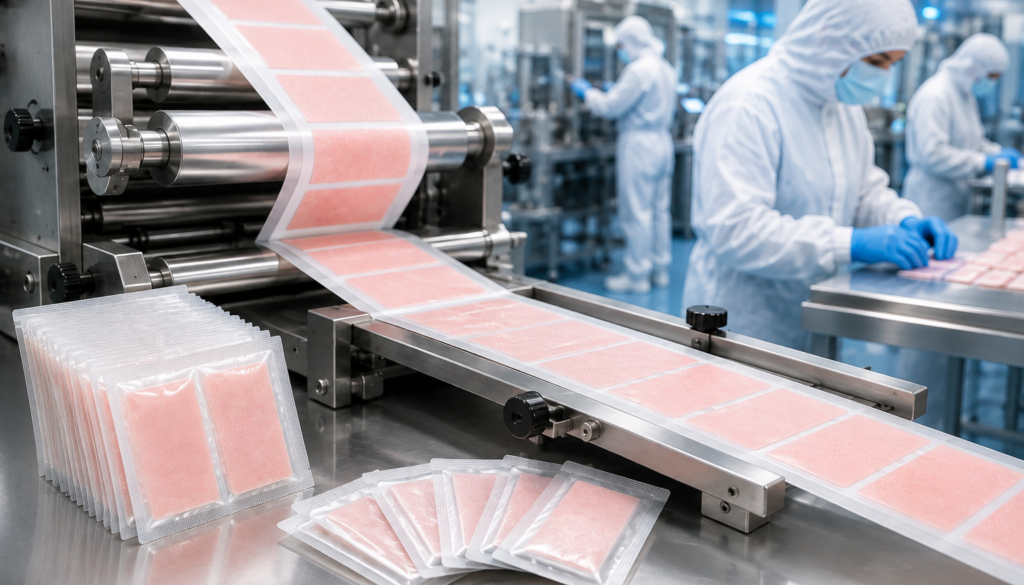
Oral Dissolving Film Contract Manufacturing: From Product Concept to Commercial Production
Oral dissolving film contract manufacturing offers pharmaceutical, nutraceutical, wellness and healthcare brands a specialised pathway for transforming an oral-film concept into a commercially manufacturable product. Instead of building dedicated formulation, casting, drying, converting and packaging capabilities internally, brands can work with an experienced contract manufacturing partner.
However, successful oral dissolving film contract manufacturing involves much more than simply providing an ingredient list and requesting production.
The complete process may include technical feasibility, formulation development, raw-material selection, taste masking, prototype development, analytical planning, pilot manufacturing, scale-up, packaging, stability evaluation, quality review and commercial production.
Understanding these stages can help brands make better manufacturing decisions, avoid costly development mistakes and create a more reliable pathway from initial concept to commercial supply.
What Is Oral Dissolving Film Contract Manufacturing?
Oral dissolving film contract manufacturing is an arrangement in which a specialised manufacturer supports some or all stages involved in developing and producing oral dissolving films for another company or brand.
Depending on the project, the manufacturing partner may support:
- Product feasibility
- Formulation development
- Raw-material sourcing
- Taste masking
- Prototype development
- Analytical testing
- Pilot batches
- Process optimisation
- Scale-up
- Commercial manufacturing
- Primary packaging
- Secondary packaging
- Stability programmes
- Product documentation
The exact scope depends on whether the project is private label, custom development or technology transfer.
How the Contract Manufacturing Process Works
A typical oral-film project can move through several interconnected stages.
| Stage | Main Objective | Typical Activities |
|---|---|---|
| Project Brief | Define product requirements | Market, formula, dose, packaging |
| Feasibility | Assess technical practicality | Loading, taste, film size |
| Development | Build the formulation | Polymer, excipients, flavour |
| Prototype | Evaluate initial films | Appearance, taste, handling |
| Analytical Planning | Define testing | Assay, uniformity, disintegration |
| Pilot Manufacturing | Test the process | Mixing, casting, drying |
| Scale-Up | Prepare commercial process | Equipment and parameter optimisation |
| Packaging | Protect the finished film | Pouch, barrier, seal evaluation |
| Stability | Evaluate product over time | Physical and chemical attributes |
| Commercial Supply | Manufacture repeat batches | Production, testing, release |
Not every project follows exactly the same pathway, but this framework helps brands understand the broader manufacturing process.
1. Begin With a Detailed Product Brief
Successful oral dissolving film contract manufacturing starts with a clear product brief.
A manufacturer should understand what the brand wants to achieve before making strong technical or commercial commitments.
The brief should ideally include:
Product Details
- Product category
- Intended use
- Destination market
- Target audience
- Proposed claims
Formula Details
- Ingredient names
- Exact ingredient forms
- Target amount per film
- Required ingredients
- Optional ingredients
Film Requirements
- Preferred film dimensions
- Flavour expectations
- Mouthfeel requirements
- Intended disintegration characteristics
Packaging Requirements
- Individual packaging format
- Number of films per pack
- Printed packaging requirements
- Secondary carton requirements
Commercial Details
- Initial order quantity
- Annual forecast
- Target launch timing
- Delivery market
A vague brief can lead to inaccurate assumptions, additional development rounds and unexpected costs.
2. Technical Feasibility Comes Before Commercial Manufacturing
Not every ingredient or formulation concept is automatically suitable for an oral dissolving film.
Before full development begins, the manufacturer may need to assess technical feasibility.
Important questions include:
- Can the target amount fit within a practical film?
- Is the ingredient form appropriate?
- Is the ingredient soluble or dispersible?
- Is the taste manageable?
- Can acceptable mouthfeel be achieved?
- Can a suitable polymer system be developed?
- Will the film remain sufficiently flexible?
- Can the formulation be manufactured consistently?
- What packaging protection may be required?
This feasibility stage is particularly important for custom oral dissolving film contract manufacturing projects.
3. Ingredient Loading Can Define the Entire Project
The amount of active or functional ingredient required in each film can significantly influence formulation development.
Higher loading may affect:
- Total solids
- Film thickness
- Film dimensions
- Flexibility
- Strength
- Taste
- Mouthfeel
- Casting
- Drying
- Disintegration
For this reason, manufacturers need more than the ingredient name.
They need the exact target amount per film.
A common mistake is asking whether an ingredient can be manufactured as an oral film without specifying the intended loading.
Feasibility should be evaluated against the actual target product.
4. Formulation Development Builds the Film System
Once feasibility has been reviewed, custom projects can move into formulation development.
An oral-film formulation may contain several functional components.
These can include:
- Active or functional ingredients
- Film-forming polymers
- Plasticisers
- Sweeteners
- Flavours
- Sensory modifiers
- Other formulation-specific excipients
Each component needs to work within the complete system.
Changing one component can influence several other characteristics.
For example, changes in polymer composition may influence:
- Viscosity
- Casting
- Film strength
- Flexibility
- Disintegration
- Mouthfeel
This interconnected behaviour is one reason why specialised oral dissolving film contract manufacturing expertise can be valuable.
5. Taste Masking Should Be Addressed Early
Taste can become a major challenge in oral-film development because the film hydrates directly in the mouth.
Ingredients may have sensory characteristics such as:
- Bitterness
- Metallic notes
- Sourness
- Astringency
- Strong herbal character
- Unpleasant aroma
- Persistent aftertaste
Taste masking may involve a combination of:
- Ingredient selection
- Sweeteners
- Flavours
- Sensory modifiers
- Aroma
- Film composition
- Disintegration behaviour
Simply adding more flavour is not always an effective solution.
A strong contract manufacturing strategy should consider taste during early development rather than attempting to correct it after the formulation has been finalised.
6. Prototype Development Tests the Concept
Prototype development allows the formulation team to convert theoretical assumptions into physical films.
Early prototypes may be evaluated for characteristics such as:
- Appearance
- Film formation
- Thickness
- Flexibility
- Strength
- Handling
- Taste
- Mouthfeel
- Disintegration
Several development iterations may be required.
A prototype may perform well in one area while creating problems in another.
For example:
Improved Strength → Slower Disintegration
or
Higher Ingredient Loading → Increased Thickness
Development therefore involves balancing multiple product attributes rather than optimising only one characteristic.
7. Analytical Planning Supports Product Quality
Analytical requirements should be considered before commercial manufacturing.
Depending on the product, testing may include:
| Test | Potential Purpose |
|---|---|
| Appearance | Physical evaluation |
| Dimensions | Unit consistency |
| Thickness | Film consistency |
| Unit Mass | Manufacturing control |
| Identity | Ingredient confirmation |
| Assay | Ingredient content |
| Content Uniformity | Unit-to-unit consistency |
| Disintegration | Film performance |
| Dissolution/Release | Product-specific performance |
| Moisture | Physical/stability monitoring |
| Impurities | Degradation monitoring |
| Microbial Quality | Product-specific quality control |
Not every oral-film project requires the same analytical package.
The testing strategy should reflect the formulation, product category and destination-market requirements.
8. Pilot Manufacturing Bridges Development and Commercial Scale
One successful laboratory film does not prove that a product is ready for commercial manufacturing.
Pilot manufacturing helps evaluate how the formulation behaves on larger or more representative equipment.
Potential areas of evaluation include:
- Mixing
- Ingredient addition
- Viscosity
- Deaeration
- Casting
- Wet-film thickness
- Drying
- Web handling
- Cutting
- Yield
Pilot work can reveal serious scale-up problems that are difficult to identify during small laboratory trials.
This makes pilot manufacturing an important stage in many oral dissolving film contract manufacturing programmes.
9. Scale-Up Requires Process Understanding
Scaling an oral-film process is not simply a matter of multiplying every laboratory parameter.
Commercial equipment may differ in:
- Vessel size
- Impeller geometry
- Mixing energy
- Casting width
- Dryer configuration
- Airflow
- Line speed
- Conversion equipment
Process parameters may therefore need to be adapted while maintaining the intended product characteristics.
Potential critical process parameters can include:
Mixing Parameters
- Order of addition
- Mixing speed
- Mixing time
- Temperature
- pH
- Viscosity
Casting Parameters
- Feed rate
- Casting gap
- Wet-film thickness
- Line speed
Drying Parameters
- Temperature
- Airflow
- Residence time
- Zone configuration
The appropriate parameters depend on the specific formulation and manufacturing equipment.
10. Drying Can Significantly Affect Film Quality
Drying is a particularly important stage of oral-film manufacturing.
Insufficient or excessive drying can potentially influence:
- Moisture
- Flexibility
- Brittleness
- Tackiness
- Flavour
- Ingredient stability
- Conversion performance
The objective is not simply to apply the highest possible temperature or remove the maximum amount of moisture.
The drying process should support the intended finished-film characteristics.
This is one area where manufacturing experience can become particularly important.
11. Conversion Creates Individual Film Units
After drying, the film web may need to be converted into individual units.
Conversion can involve:
- Slitting
- Cutting
- Dimensional control
- Web handling
- Inspection
Consistent dimensions can be important because the formulation is distributed across the film.
Conversion therefore needs to work together with casting uniformity and other process controls.
Poor conversion can create avoidable quality problems even when the formulation itself is successful.
12. Packaging Protects the Finished Oral Film
Packaging should be considered part of the product-development strategy.
Oral films may be sensitive to:
- Moisture
- Oxygen
- Light
- Temperature
- Physical handling
Possible packaging formats may include individually sealed pouches, sachets or other qualified systems appropriate to the product.
Packaging selection may consider:
- Barrier properties
- Material compatibility
- Seal integrity
- Printability
- Package dimensions
- Manufacturing equipment
- Consumer convenience
- Destination market
A technically successful oral film can still experience serious stability problems if packaging protection is inadequate.
13. Stability Should Be Planned With Packaging
Stability and packaging are closely connected.
Depending on the project, stability evaluation may consider:
- Appearance
- Film flexibility
- Mechanical properties
- Assay
- Impurities
- Disintegration
- Moisture
- Taste
- Aroma
- Package integrity
The final or representative packaging configuration should be considered where appropriate.
Shelf-life decisions should be based on suitable evidence rather than assumptions.
A manufacturer making unrealistic shelf-life guarantees without appropriate evaluation should be treated as a red flag.
14. Quality Systems Support Repeatable Manufacturing
Commercial oral dissolving film contract manufacturing requires more than producing an acceptable prototype.
Repeatable manufacturing depends on controlled quality systems.
Potential areas include:
- Raw-material qualification
- Supplier management
- Manufacturing documentation
- In-process controls
- Finished-product specifications
- Analytical testing
- Deviations
- Change control
- Batch release
- Traceability
- Complaint management
The appropriate quality framework depends on the product and market.
Brands should therefore evaluate quality capability before selecting a manufacturing partner.
15. Private Label, Custom Development or Technology Transfer?
There are several possible contract-manufacturing pathways.
Private Label
Private label may be suitable when the manufacturer already has a qualified product concept that closely matches the brand’s requirements.
The project may focus more on:
- Product selection
- Flavour
- Packaging
- Branding
- Documentation
- Commercial supply
Custom Development
Custom development may be appropriate when a brand requires a differentiated formulation.
This can involve:
- Feasibility
- Formulation development
- Prototypes
- Taste masking
- Analytical work
- Pilot manufacturing
- Scale-up
- Stability
- Packaging
Technology Transfer
Technology transfer may be appropriate when the brand already owns or controls an existing formulation or manufacturing process.
The receiving manufacturer may need to evaluate:
- Formula transferability
- Raw materials
- Equipment compatibility
- Process parameters
- Analytical methods
- Specifications
- Packaging
- Stability
Choosing the correct pathway can improve project efficiency.
Oral Dissolving Film Contract Manufacturing Cost Drivers
There is no universal manufacturing price for every oral-film project.
Cost may depend on:
| Cost Driver | Potential Impact |
|---|---|
| Formula Status | Development requirements |
| Ingredient Cost | Raw-material expense |
| Ingredient Loading | Material and process complexity |
| Taste Masking | Development work |
| Analytical Testing | Testing expense |
| Pilot Work | Scale-up requirements |
| Packaging | Material and printing costs |
| Stability | Programme requirements |
| Batch Size | Manufacturing economics |
| Documentation | Project-specific support |
Brands should compare the complete project cost rather than only the price per film.
Understanding MOQ
Minimum order quantity in oral dissolving film contract manufacturing may be influenced by several factors.
Manufacturing MOQ
The minimum practical production quantity.
Raw-Material MOQ
The minimum quantity required by ingredient suppliers.
Packaging MOQ
The minimum quantity required for printed pouches, cartons or other components.
Commercial MOQ
The final quantity offered after considering manufacturing, materials, packaging and economics.
This distinction is important because the lowest technically possible manufacturing quantity may not always be the lowest commercially practical order.
What Makes a Strong Contract Manufacturing Partner?
Positive signs include a manufacturer that:
- Requests detailed product information
- Reviews ingredient forms
- Evaluates target loading
- Discusses technical limitations
- Considers taste and mouthfeel
- Explains pilot and scale-up requirements
- Defines analytical requirements
- Discusses packaging and stability
- Explains MOQ
- Provides transparent commercial assumptions
- Uses structured quality systems
- Plans for repeat commercial supply
A reliable partner should be willing to identify technical uncertainties rather than promising immediate success for every concept.
Serious Red Flags to Avoid
Be cautious if a manufacturer:
- Guarantees every formulation without review
- Provides final pricing from only an ingredient name
- Ignores ingredient loading
- Does not discuss taste
- Cannot explain scale-up
- Has unclear testing capabilities
- Ignores packaging requirements
- Guarantees shelf life without evidence
- Cannot explain MOQ
- Has unclear change-control procedures
These dangerous red flags can create costly technical and commercial problems.
Common Contract Manufacturing Mistakes
Choosing Only by Price
The cheapest quote may exclude important development, testing or packaging activities.
Ignoring Technical Feasibility
A commercially attractive concept may still require substantial formulation work.
Not Defining Ingredient Forms
Different grades and forms can behave differently.
Ignoring Taste Until Late Development
Taste problems can force significant formulation changes.
Skipping Scale-Up Evaluation
Laboratory success does not guarantee commercial reproducibility.
Treating Packaging as an Afterthought
Packaging can influence stability and commercial viability.
Assuming Shelf Life
Shelf-life expectations should be supported appropriately.
Ignoring MOQ Components
Manufacturing, ingredients and packaging may have different minimum quantities.
Avoiding these costly mistakes can improve project planning.
Contract Manufacturing Partner Evaluation Checklist
Brands can compare potential manufacturers using a structured checklist.
| Evaluation Area | Score 1–5 |
|---|---|
| ODF Development Expertise | |
| Ingredient-Loading Capability | |
| Taste-Masking Capability | |
| Prototype Development | |
| Pilot Manufacturing | |
| Scale-Up Capability | |
| Analytical Capability | |
| Quality Systems | |
| Packaging Capability | |
| Stability Support | |
| Documentation | |
| MOQ Suitability | |
| Pricing Transparency | |
| Communication | |
| Commercial Capacity |
A score should be based on evidence and project fit rather than marketing claims alone.
Questions to Ask an Oral Dissolving Film Contract Manufacturer
Before selecting a partner, ask:
- Which oral-film product categories do you support?
- Do you offer custom formulation development?
- Do you offer private-label options?
- Can you support technology transfer?
- How do you assess ingredient loading?
- How do you approach taste masking?
- What prototype process is used?
- How do you manage pilot manufacturing?
- How is commercial scale-up approached?
- What analytical capabilities are available?
- How are product specifications established?
- Which packaging formats can be supported?
- How is stability addressed?
- What determines MOQ?
- Which development costs are one-time?
- What is included in commercial pricing?
- What documentation is available?
- How are manufacturing changes controlled?
- What lead-time stages should be expected?
- How is repeat commercial supply planned?
Clear answers can help identify whether the manufacturer is a suitable long-term partner.
How to Prepare Your Contract Manufacturing Enquiry
Before requesting a quotation, prepare a structured RFQ.
Product
- Product category
- Destination market
- Intended use
- Target consumer
Formula
- Ingredient names
- Ingredient forms
- Target amount per film
- Required ingredients
Sensory Requirements
- Preferred flavour
- Known taste challenges
- Mouthfeel expectations
Film
- Desired dimensions
- Performance expectations
Packaging
- Primary packaging
- Pack count
- Printed packaging
- Secondary packaging
Commercial
- Initial quantity
- Annual forecast
- Launch timeline
- Delivery destination
Technical
- Development status
- Testing requirements
- Stability requirements
- Documentation needs
A detailed enquiry allows the manufacturer to provide more accurate technical and commercial feedback.
Frequently Asked Questions
What is oral dissolving film contract manufacturing?
Oral dissolving film contract manufacturing is an arrangement where a specialised manufacturer supports development and/or commercial production of oral dissolving films for another brand or company.
Can a contract manufacturer develop a custom oral film?
Potentially, depending on its capabilities. Custom development may involve feasibility, formulation, taste masking, prototypes, analytical work, pilot manufacturing, scale-up, packaging and stability.
Can existing formulations be transferred to another manufacturer?
Potentially. Technology transfer may require assessment of raw materials, equipment, process parameters, analytical methods, specifications and packaging.
How is oral-film MOQ determined?
MOQ can depend on manufacturing batch size, ingredient purchasing requirements, packaging minimums, testing and commercial economics.
What affects oral-film manufacturing cost?
Formula status, ingredient cost, loading, development, analytical testing, packaging, batch size, stability and documentation can all influence cost.
Why is taste masking important?
The film hydrates directly in the mouth, making unpleasant ingredient tastes and aftertastes potentially noticeable to the consumer.
Is a successful laboratory prototype ready for commercial manufacturing?
Not necessarily. Pilot manufacturing and scale-up may reveal differences involving mixing, casting, drying and other process parameters.
Why is packaging important for oral dissolving films?
Packaging can help protect the product from environmental factors such as moisture, oxygen, light and physical handling depending on the formulation.
Can a manufacturer guarantee shelf life immediately?
Shelf-life decisions should be supported by appropriate product-specific evidence rather than unsupported guarantees.
What should I provide when requesting a contract manufacturing quote?
Provide the destination market, ingredient forms, amount per film, product requirements, packaging, development status, initial order quantity and annual forecast.
From Product Concept to Reliable Commercial Production
Successful oral dissolving film contract manufacturing requires a connected development and manufacturing strategy.
Ingredient feasibility, formulation, taste masking, prototypes, analytical planning, pilot manufacturing, scale-up, drying, conversion, packaging, stability and quality controls all contribute to the final product.
The best approach is to define the product clearly, identify technical risks early and select a manufacturing partner whose capabilities match the actual project.
This can help brands avoid costly mistakes, dangerous assumptions, development delays and unexpected commercial problems while creating a stronger pathway toward repeatable commercial production.
Lagom Life Sciences reviews qualified oral-film projects across private-label, custom-development, technology-transfer and contract-manufacturing pathways. Product feasibility, formulation, analytical requirements, scale-up, packaging, stability, MOQ and commercial supply should be confirmed through project-specific technical, quality and commercial review.
Ready to explore your oral dissolving film project? Request a contract manufacturing discussion with Lagom Life Sciences.