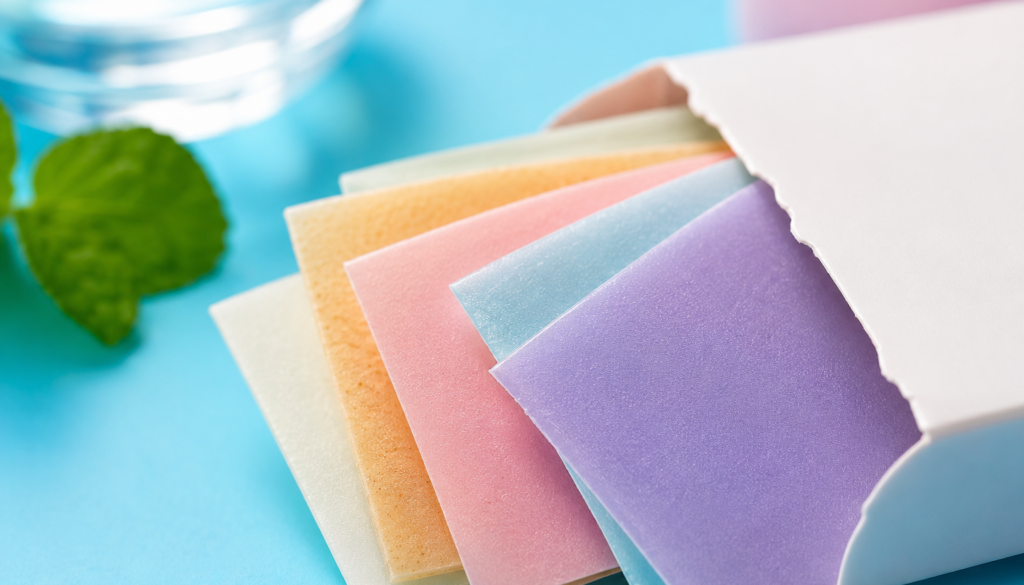
Oral Disintegrating Strips: A Complete Guide
Oral disintegrating strips are thin, flexible dosage forms designed to dissolve or disintegrate quickly in the mouth. They are gaining attention in pharmaceutical and healthcare product development because they can offer a convenient alternative to conventional tablets and capsules.
These strips are particularly useful for people who may have difficulty swallowing conventional solid dosage forms. Their thin format, ease of administration, and potential for rapid drug release make them an interesting option for pharmaceutical companies developing patient-friendly dosage forms.
The development of oral disintegrating strips involves careful consideration of active pharmaceutical ingredients, film-forming polymers, plasticizers, taste-masking agents, manufacturing processes, packaging, stability, and quality requirements.
This guide explains what oral disintegrating strips are, how they work, their advantages, manufacturing process, applications, formulation considerations, and important factors to consider when developing these products.
What Are Oral Disintegrating Strips?
Oral disintegrating strips are thin pharmaceutical films placed inside the mouth, where they rapidly hydrate and disintegrate.
Unlike conventional tablets, these strips do not require the patient to swallow a solid tablet. Once placed on the tongue or another appropriate area of the mouth, the strip interacts with saliva and begins to dissolve or disintegrate.
Depending on the formulation, the active ingredient can then be released for absorption.
Oral disintegrating strips may be designed for different pharmaceutical applications and can contain suitable active pharmaceutical ingredients along with excipients required to create a stable and functional film.
How Do Oral Disintegrating Strips Work?
The basic mechanism of an oral strip involves contact with saliva.
When the strip is placed in the mouth:
- Saliva hydrates the film.
- The film begins to swell and disintegrate.
- The active ingredient is released.
- The formulation breaks down into smaller components.
- The active ingredient becomes available according to the characteristics of the formulation.
The actual release and absorption profile depends on the active ingredient, formulation composition, manufacturing process, and intended route of administration.
Why Are Oral Disintegrating Strips Becoming Popular?
One of the main reasons for developing oral disintegrating strips is convenience.
Traditional tablets and capsules may be difficult for certain patients to swallow. A thin oral film can provide an alternative dosage format that is easier to administer.
Easy Administration
The thin format can be convenient for patients who have difficulty swallowing conventional tablets.
No Need for Water
Depending on the specific formulation and product instructions, oral strips can be administered without requiring a glass of water.
This can be particularly convenient when access to water is limited.
Portable Dosage Form
The thin and lightweight nature of oral films can make them convenient for carrying and storing.
Patient-Friendly Format
A properly designed oral strip can provide a simple administration experience.
These characteristics make oral disintegrating strips an attractive area for pharmaceutical formulation development.
Advantages of Oral Disintegrating Strips
Oral strips offer several potential advantages compared with conventional solid dosage forms.
Rapid Disintegration
The thin film structure provides a large surface area relative to its thickness, allowing saliva to interact with the formulation quickly.
Convenience
The format can be useful for patients who prefer dosage forms that are easy to administer.
Improved Patient Acceptability
A well-designed strip can provide a more convenient experience than swallowing a conventional tablet.
Precise Dose Delivery
Manufacturing processes can be designed to achieve uniform distribution of the active ingredient throughout the film.
However, achieving consistent drug loading requires careful formulation and process control.
Ingredients Used in Oral Disintegrating Strips
The formulation of oral disintegrating strips generally includes several components that work together to produce the desired film characteristics.
Active Pharmaceutical Ingredient
The active pharmaceutical ingredient, or API, provides the therapeutic activity.
The suitability of an API for oral film formulation depends on factors such as:
- Dose requirement
- Solubility
- Stability
- Taste
- Particle characteristics
- Compatibility with formulation ingredients
Film-Forming Polymers
Film-forming polymers provide the structural foundation of the strip.
The selected polymer should provide suitable:
- Film strength
- Flexibility
- Disintegration
- Compatibility
- Stability
The choice of polymer depends on the formulation and desired product characteristics.
Plasticizers
Plasticizers can improve film flexibility and reduce brittleness.
They help produce films that can withstand handling and packaging processes.
Sweeteners
Sweeteners may be incorporated to improve palatability, particularly when the active ingredient has an unpleasant taste.
Flavoring Agents
Flavoring agents can help improve the sensory experience of the dosage form.
Taste-Masking Ingredients
Taste masking is particularly important for APIs with bitter or unpleasant flavors.
A suitable taste-masking strategy can improve patient acceptability.
Taste Masking in Oral Disintegrating Strips
Taste is one of the most important formulation challenges in oral films because the active ingredient comes into direct contact with the oral environment.
Some APIs have strong bitter or unpleasant tastes.
If the taste is not properly controlled, patients may reject the product.
Common Taste-Masking Approaches
Depending on the API, formulation developers may consider:
- Sweeteners
- Flavors
- Complexation
- Polymer-based approaches
- Coating
- Ion-exchange approaches
- Particle engineering
The appropriate approach depends on the characteristics of the API.
Manufacturing Process of Oral Disintegrating Strips
The manufacturing process must be carefully controlled to achieve consistent film quality and drug content.
Several manufacturing approaches can be used depending on the formulation and production requirements.
Solvent Casting Method
Solvent casting is one of the commonly used approaches for producing oral films.
In a typical process:
- Ingredients are selected and weighed.
- The polymer is dispersed or dissolved in an appropriate solvent system.
- Other formulation ingredients are incorporated.
- The API is added and uniformly distributed.
- The formulation is mixed to achieve appropriate consistency.
- The mixture is cast into a controlled film layer.
- The film is dried.
- The dried film is cut into individual doses.
- The finished strips are packaged.
Process parameters must be carefully controlled to achieve uniformity.
Film Thickness
Film thickness is an important quality attribute.
Variations in thickness can affect:
- Drug content
- Disintegration time
- Mechanical strength
- Appearance
- Dissolution characteristics
Manufacturers therefore need appropriate controls to maintain consistent film thickness.
Drug Content Uniformity
Uniform distribution of the active ingredient is critical.
Each strip should contain the intended amount of active ingredient within the applicable specifications.
This can become more challenging when the API dose is very low or when the formulation contains suspended particles.
Proper mixing and process control are therefore essential.
Disintegration Time
Disintegration time is another important quality characteristic.
The strip should disintegrate within the intended time under appropriate test conditions.
The formulation can be optimized by adjusting:
- Polymer type
- Polymer concentration
- Plasticizer level
- Film thickness
- Other excipients
The desired disintegration profile depends on the product design.
Mechanical Strength of Oral Strips
Although rapid disintegration is important, the strip must also be strong enough to withstand:
- Manufacturing
- Cutting
- Packaging
- Transportation
- Handling by the consumer
A film that disintegrates too quickly may lack sufficient mechanical strength.
Therefore, formulation development requires a balance between rapid disintegration and adequate physical durability.
Packaging of Oral Disintegrating Strips
Packaging is particularly important because thin oral films can be sensitive to environmental conditions.
Depending on the formulation, moisture and humidity may affect:
- Film strength
- Flexibility
- Disintegration
- Stability
- Appearance
Individual Sachets
Individual sachets can provide protection from environmental exposure while keeping each dose separately packaged.
Blister Packaging
Blister packaging can also provide individual-dose protection.
Moisture Protection
Appropriate moisture-barrier packaging can help maintain product quality throughout its shelf life.
The packaging system should be selected based on stability studies and product requirements.
Stability Considerations
Stability is a critical part of oral film development.
The formulation should be evaluated under appropriate storage conditions to determine whether the product maintains its required characteristics throughout its shelf life.
Stability evaluation may consider:
- Appearance
- Film integrity
- Drug content
- Impurities
- Disintegration
- Dissolution
- Moisture
- Microbiological quality, where applicable
Packaging selection is closely connected to stability performance.
Quality Testing for Oral Disintegrating Strips
Quality control testing helps ensure consistency between batches.
Depending on the product, testing may include:
Appearance
The film should meet defined requirements for:
- Color
- Surface
- Uniformity
- Physical defects
Thickness
Film thickness should remain within the specified range.
Weight Variation
Individual strips may be evaluated for weight uniformity.
Drug Content
Testing confirms that the active ingredient is present at the intended concentration.
Content Uniformity
Content uniformity testing is particularly important for low-dose formulations.
Disintegration
The time required for the strip to disintegrate is evaluated according to the applicable test method.
Dissolution
Dissolution testing can be used to evaluate drug release characteristics where applicable.
Applications of Oral Disintegrating Strips
Oral disintegrating strips can be developed for different types of pharmaceutical and healthcare applications, depending on the active ingredient and formulation requirements.
Potential applications may include:
- Prescription medicines
- Over-the-counter products
- Nutraceuticals
- Vitamins
- Minerals
- Supplements
- Wellness products
- Pediatric-friendly formulations
- Geriatric-friendly formulations
The suitability of the strip format depends on the specific active ingredient and intended use.
Oral Disintegrating Strips for Pediatric Products
Pediatric dosage forms often require special attention to administration convenience and palatability.
Children may have difficulty swallowing conventional tablets or capsules.
A properly formulated oral strip can provide a convenient alternative dosage form.
Taste masking becomes particularly important for pediatric applications because unpleasant taste can significantly affect acceptance.
Oral Disintegrating Strips for Geriatric Patients
Older adults may also experience difficulties swallowing conventional dosage forms.
Oral strips can provide an alternative format that may be easier to administer.
The formulation should consider:
- Ease of handling
- Taste
- Film size
- Disintegration time
- Dose requirements
Oral Disintegrating Strips vs Tablets
Both dosage forms have advantages and limitations.
| Feature | Oral Disintegrating Strips | Conventional Tablets |
| Physical format | Thin film | Solid tablet |
| Administration | Placed in mouth | Swallowed |
| Water requirement | May not require water | Often taken with water |
| Portability | High | High |
| Swallowing difficulty | May be easier | Can be challenging |
| Taste considerations | Important | Usually less direct |
| Manufacturing | Film-based process | Tablet compression process |
The appropriate dosage form depends on the active ingredient, patient population, formulation objectives, and commercial requirements.
Oral Disintegrating Strips vs Oral Dissolving Films
The terms oral disintegrating strips and oral dissolving films are sometimes used similarly, but product terminology can vary.
Both refer to thin oral film dosage forms designed to break down in the mouth.
The exact terminology may depend on:
- Product design
- Regulatory classification
- Intended release behavior
- Marketing terminology
- Manufacturer specifications
Businesses should use terminology that accurately reflects the characteristics and regulatory positioning of their product.
Challenges in Oral Disintegrating Strip Development
Despite their advantages, oral strips present several formulation and manufacturing challenges.
Taste
Bitter APIs can be difficult to formulate into acceptable oral strips.
Dose Loading
High-dose APIs can be challenging because the strip must remain thin while containing the required amount of active ingredient.
Moisture Sensitivity
Some films can absorb moisture, affecting mechanical and disintegration properties.
Content Uniformity
Uniform API distribution is essential, particularly for low-dose products.
Mechanical Properties
The film must balance flexibility, strength, and rapid disintegration.
Stability
Both formulation and packaging must be optimized to maintain product quality throughout the intended shelf life.
How to Choose an Oral Film Manufacturer
Companies looking to commercialize oral disintegrating strips should carefully evaluate potential manufacturing partners.
Important factors include:
Formulation Development Experience
The manufacturer should have experience developing oral film formulations and understanding film-forming polymers, plasticizers, taste masking, and drug loading.
Manufacturing Equipment
Evaluate whether the facility has appropriate equipment for:
- Mixing
- Casting
- Drying
- Cutting
- Inspection
- Packaging
Quality Systems
The manufacturer should have appropriate quality management systems and manufacturing controls.
Packaging Capabilities
The manufacturer should be able to provide packaging that protects the film from moisture and environmental exposure.
Scale-Up Capability
A development partner should ideally be capable of supporting the transition from laboratory development to commercial production.
Contract Manufacturing of Oral Disintegrating Strips
Contract manufacturing can allow pharmaceutical companies to outsource oral film production to specialized manufacturers.
A contract manufacturer may provide:
- Formulation development
- Pilot batches
- Scale-up
- Commercial manufacturing
- Testing
- Packaging
- Documentation
This can reduce the infrastructure investment required by pharmaceutical companies.
Future of Oral Disintegrating Strips
The demand for patient-friendly dosage forms continues to encourage innovation in oral film technology.
Potential areas of development include:
- Improved taste masking
- Faster disintegration
- Better mechanical strength
- Higher drug loading
- Improved stability
- Advanced packaging
- Specialized formulations
Pharmaceutical companies are also exploring oral film technologies for different active ingredients and healthcare applications.
Conclusion
Oral disintegrating strips are thin dosage forms designed to rapidly disintegrate in the mouth and provide a convenient alternative to conventional tablets and capsules.
Their advantages can include ease of administration, portability, potential water-free administration, and suitability for patients who experience difficulty swallowing conventional solid dosage forms.
However, successful oral strip development requires careful attention to formulation design, taste masking, film strength, drug loading, disintegration, content uniformity, stability, manufacturing processes, and packaging.
For pharmaceutical companies, selecting an experienced development and manufacturing partner can be an important step toward successfully commercializing an oral strip product. A capable partner should understand the technical challenges of oral film formulation and have appropriate development, manufacturing, quality, testing, and packaging capabilities.
With continued advances in formulation science, manufacturing technology, taste masking, and packaging, oral disintegrating strips can remain an important dosage-form option for pharmaceutical and healthcare product development.