
Oral Dissolving Films: The Ultimate Buyer’s Guide for Product Teams
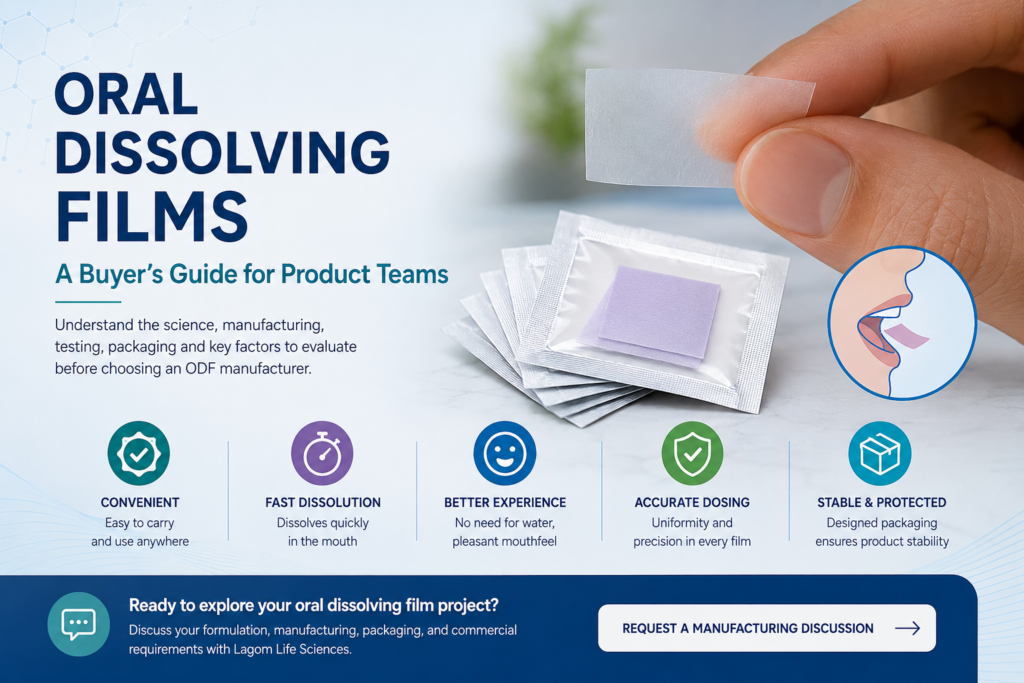
Oral dissolving films are gaining attention as an innovative dosage format for pharmaceutical, nutraceutical and wellness product development. Thin, flexible and designed for placement in the mouth, these films can offer a convenient alternative format for suitable product concepts.
However, developing a successful oral film is not as simple as converting a tablet, capsule or powder formulation into a thin strip.
This is one of the critical mistakes product teams can make during early development.
An oral film represents an interconnected product system involving the active or functional ingredient, film-forming polymer, excipients, sensory profile, manufacturing process, testing strategy, packaging and intended market requirements.
For buyers and product teams, the key question therefore should not simply be:
“Can this ingredient be made into an oral strip?”
A better question is:
“Can the ingredient, target amount, film properties, consumer experience, manufacturing process, packaging and market requirements work successfully together?”
This comprehensive buyer’s guide explains the essential factors to evaluate before approaching an oral dissolving film manufacturer.
What Are Oral Dissolving Films?
Oral dissolving films are thin and flexible dosage forms intended to be placed in the mouth and designed to disintegrate or dissolve according to a defined target product profile.
Depending on the market and intended application, related terminology may include:
- Oral thin films
- ODFs
- Mouth-dissolving strips
- Oral soluble films
- Orodispersible films
Although these terms are sometimes used broadly, product teams should be careful about assuming that every oral film works in exactly the same way.
The intended placement, formulation and performance need to be clearly established during product development.
Why Are Oral Dissolving Films Different?
An oral film should not be viewed simply as a conventional tablet formulation made thinner.
This is an important distinction.
A film is a connected formulation and manufacturing system in which changing one component can influence several other characteristics.
A typical formulation may include:
- Film-forming polymer
- Active or functional ingredient
- Plasticisers
- Processing aids
- Flavours
- Sweeteners
- Sensory modifiers
- Ingredients influencing pH or stability
- Suitable protective packaging
The available space within a thin film is limited.
As ingredient loading increases, developers may face challenging issues involving film thickness, flexibility, taste, uniformity, drying behaviour and disintegration.
Therefore, feasibility assessment is a crucial first step.
7 Critical Factors That Determine Oral Dissolving Film Feasibility
Before moving towards commercial development, product teams should evaluate several interconnected factors.
1. Ingredient Identity and Form
Knowing only the ingredient name is usually insufficient.
Developers may need information regarding:
- Ingredient grade
- Salt or chemical form
- Botanical extract ratio
- Carrier system
- Supplier specification
- Particle characteristics
- Storage requirements
Different forms of the same ingredient may behave differently during formulation and processing.
For example, ingredient characteristics can influence solubility, taste, stability, appearance and distribution within the film.
This makes detailed raw-material information an essential starting point.
2. Target Amount Per Film
One of the most significant limitations of thin-film dosage forms is available loading space.
A technically suitable ingredient does not automatically mean that the desired quantity will fit into a practical film.
Higher loading may negatively affect:
- Thickness
- Flexibility
- Mechanical strength
- Uniformity
- Casting behaviour
- Drying
- Taste
- Mouthfeel
- Disintegration
This is why promising a formulation before completing feasibility work can create serious development problems.
Product teams should clearly define the target amount per film before requesting quotations or timelines.
3. Taste and Mouthfeel
Taste can become a major challenge because the film is used directly in the mouth.
Potential undesirable sensory characteristics include:
- Bitterness
- Metallic notes
- Astringency
- Grittiness
- Strong herbal notes
- Persistent aftertaste
Simply adding more flavour may not solve these problems.
A successful formulation may require a layered sensory approach involving sweeteners, flavours, modifiers and formulation adjustments.
The final goal should be an acceptable consumer experience without compromising essential film performance.
4. Ingredient Compatibility
Every component needs to function as part of the complete formulation.
Potential interactions may occur between:
- Active ingredients
- Functional ingredients
- Polymers
- Sweeteners
- Flavours
- Processing aids
- Other excipients
Compatibility problems can potentially affect physical properties, stability or manufacturing performance.
Therefore, compatibility should be evaluated during formulation development rather than assumed.
5. Stability
A film may look excellent immediately after production but still develop unwanted problems during storage.
Relevant environmental factors can include:
- Moisture
- Oxygen
- Light
- Temperature
These may affect both the film itself and sensitive ingredients.
Stability considerations should therefore begin during product development—not after the product has already been finalised.
6. Destination-Market Requirements
Product teams should identify the intended market early.
Requirements can differ between countries and product categories.
Important considerations may include:
- Product classification
- Ingredient status
- Claims
- Evidence requirements
- Testing
- Labelling
- Registration or notification responsibilities
- Import requirements
Manufacturing capability alone does not automatically establish regulatory acceptability in every destination market.
This is particularly important for companies planning international distribution.
7. Commercial Scale
Commercial expectations should also be discussed early.
A manufacturer may need information regarding:
- Initial launch volume
- Annual forecast
- Packaging quantity
- Future scale requirements
Volume assumptions can influence sourcing, manufacturing, packaging and project economics.
Providing realistic forecasts can therefore lead to a more effective commercial discussion.
How Are Oral Dissolving Films Manufactured?
A commonly used manufacturing approach is solvent casting.
Although the exact process depends on the formula, product and manufacturing equipment, a typical workflow involves several stages.
Step 1: Material Preparation
Approved ingredients are verified and dispensed.
The order of addition can be important because film-forming polymers require appropriate hydration or dissolution while other ingredients need to be distributed consistently.
Important parameters may include:
- Mixing time
- Mixing speed
- Temperature
- pH
- Solids content
- Viscosity
- Hold time
Step 2: Creating a Homogeneous Solution or Dispersion
The ingredients are combined into a suitable polymer-based solution or dispersion.
Some ingredients may dissolve completely while others remain dispersed.
The objective is to achieve appropriate distribution before casting.
Poor control at this stage can create significant quality risks later.
Step 3: Deaeration
Entrapped air can contribute to:
- Bubbles
- Voids
- Visual defects
- Thickness variation
The prepared liquid may therefore undergo a controlled deaeration stage.
The method used depends on the formulation and manufacturing process.
Step 4: Casting
The prepared solution or dispersion is cast onto a suitable carrier as a wet web.
Variables may include:
- Casting gap
- Feed consistency
- Web width
- Line speed
- Viscosity
- Temperature
Small variations can influence the properties of the dried film.
Step 5: Controlled Drying
The wet web is dried under defined conditions.
Drying is a critical manufacturing stage.
Excessive drying conditions may negatively affect sensitive ingredients or flavours, while insufficient drying can contribute to tackiness, weakness or stability concerns.
Development teams therefore need to balance drying efficiency with product quality.
Step 6: Inspection and Conversion
After drying, the film web can be inspected and converted into individual units.
Relevant controls may include:
- Appearance
- Thickness
- Dimensions
- Unit mass
- Cutting accuracy
- Yield
Representative sampling is important because variation can potentially occur at different positions across the web.
Step 7: Protective Packaging
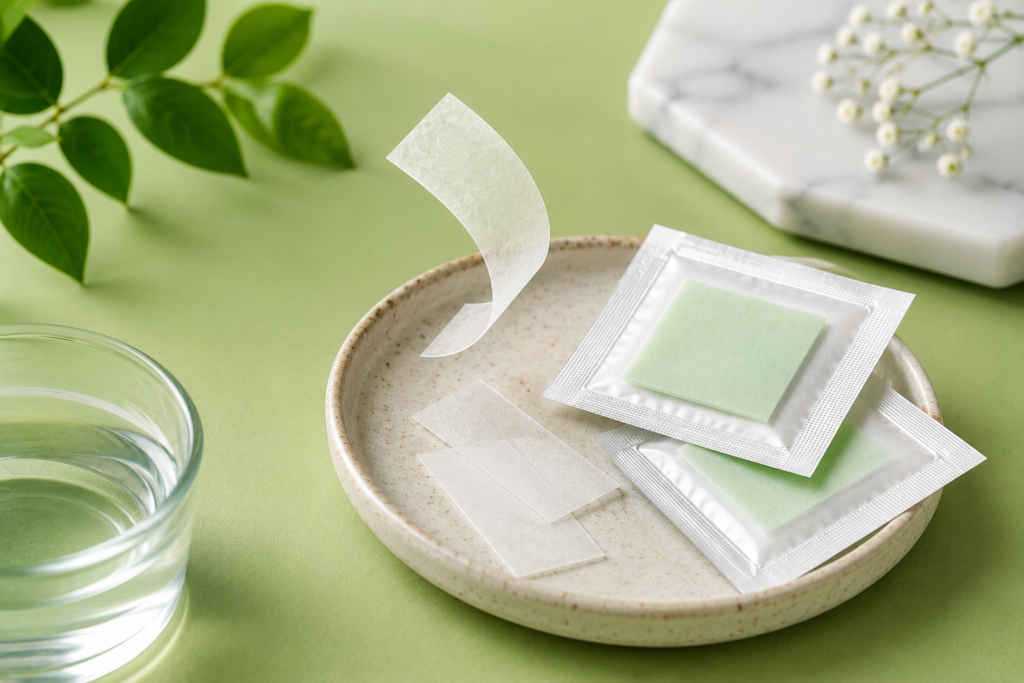
Once converted, individual films require suitable packaging.
Environmental exposure after drying can affect moisture content and handling properties.
For this reason, packaging should be treated as part of the complete product system, not simply as branding.
Why Packaging Is Critical for Oral Dissolving Films
Thin films can be sensitive to environmental conditions.
Moisture changes, for example, may influence:
- Flexibility
- Brittleness
- Tack
- Mechanical strength
- Disintegration
- Flavour release
- Ingredient stability
Oxygen and light may also influence susceptible components.
Individually sealed pouches or suitable blister formats may be considered depending on the product.
However, selecting a material marketed as “high barrier” does not automatically guarantee adequate protection.
Finished packaging performance can also depend on:
- Seal integrity
- Sealing conditions
- Package dimensions
- Puncture resistance
- Opening design
- Storage
- Transportation
This is why packaging and stability development should be connected.
What Quality Tests May Be Important?
Testing requirements vary according to the product and destination market.
Depending on the specific oral film, the quality strategy may evaluate:
- Appearance
- Dimensions
- Mass
- Thickness
- Mechanical properties
- Disintegration
- Dissolution or release
- Identity
- Assay
- Content uniformity
- Impurities
- Moisture
- Residual solvent
- Microbial quality
- Package integrity
A dangerous assumption would be to use exactly the same testing specification for every oral film.
The testing package should be appropriate for the intended product.
Private Label vs Custom Development vs Technology Transfer
Buyers should also identify which development pathway fits their project.
Private-Label Oral Dissolving Films
Private label generally starts with a suitable existing product concept.
The buyer may focus on elements such as:
- Branding
- Market
- Packaging
- Flavour
- Positioning
- Commercial requirements
However, major changes to ingredients, quantities, film properties or packaging may require additional development.
Private label can be an effective option when a suitable existing concept supports the brand strategy.
Custom Oral Film Development
Custom development begins with a differentiated product objective.
The programme may involve:
- Ingredient feasibility
- Loading assessment
- Polymer selection
- Excipient selection
- Taste masking
- Prototype development
- Analytical planning
- Pilot work
- Scale-up
- Stability
- Packaging
This route can be valuable when differentiation is central to the proposed product.
Technology Transfer
Technology transfer is relevant when an existing formulation, manufacturing process and supporting data package are being transferred to another manufacturing environment.
The receiving manufacturer may evaluate:
- Formula
- Materials
- Process parameters
- Equipment compatibility
- Analytical methods
- Specifications
- Packaging
- Stability
- Commercial scale
A technology transfer should not be treated as simply handing over a formula.
How to Choose the Right Oral Dissolving Film Manufacturer
Selecting the right manufacturing partner is a critical business decision.
Price alone should not determine the choice.
Product teams should investigate the manufacturer’s capabilities across several areas.
Formulation Capability
Ask whether the manufacturer can evaluate ingredient loading, polymer compatibility, taste masking, mouthfeel and film performance.
A reliable technical partner should be willing to identify uncertainties rather than immediately promise that every concept is feasible.
Scale-Up Knowledge
A successful laboratory prototype does not automatically guarantee successful commercial manufacturing.
Commercial equipment introduces differences involving:
- Mixing geometry
- Batch volume
- Casting width
- Drying capacity
- Line speed
- Web handling
The manufacturer should have a structured approach for moving from prototype to commercial readiness.
Quality Systems
Discuss:
- Raw-material controls
- Specifications
- In-process checks
- Analytical methods
- Stability
- Deviations
- Change control
- Batch release
Quality requirements should be product-specific.
Packaging Capability
Ask how the manufacturer selects and evaluates packaging.
Packaging decisions should consider both technical protection and commercial practicality.
Communication
A strong partner should provide clear stage gates, responsibilities, assumptions and project documentation.
Poor communication is a major warning sign, especially when technical uncertainties are involved.
Red Flags Buyers Should Never Ignore
When evaluating an oral dissolving films manufacturer, be cautious of the following warning signs:
- Guaranteed feasibility before reviewing the formula
- Unrealistic performance promises
- Guaranteed shelf life without supporting stability evidence
- No distinction between different oral-film formats
- Unclear responsibility for regulatory requirements
- Quotations without defined formula, packaging and volume assumptions
- Lack of clarity around specifications
- Poor change-control procedures
- Unrealistically fast commercial timelines
These serious red flags can create avoidable technical and commercial risks.
Questions to Ask Before Requesting a Manufacturing Quote
Prepare the following information before contacting a manufacturer:
- What is the destination market?
- What product category is intended?
- Which ingredients are required?
- What is the exact ingredient form?
- What amount is required per film?
- What claims are proposed?
- What flavour profile is preferred?
- What film performance is expected?
- What packaging format is required?
- What is the initial launch quantity?
- What is the expected annual volume?
- What documentation is required?
- What is the target launch timing?
Providing these details helps the manufacturer evaluate the project more accurately.
Benefits of a Well-Planned Oral Film Project
When technical and commercial requirements are properly defined, product teams can gain several important advantages.
These include:
- Better feasibility decisions
- More focused formulation development
- Clearer communication
- Improved risk identification
- More appropriate packaging selection
- Better quotation comparisons
- More realistic timelines
- Stronger commercial planning
The biggest advantage is not simply creating a film—it is developing a product whose formulation, manufacturing process, quality strategy and packaging work together.
Common Mistakes to Avoid
Product teams should avoid several costly mistakes.
Do not assume that:
- Every tablet formula can become an oral film
- Every ingredient can fit at any desired amount
- More flavour automatically solves bitterness
- Laboratory success guarantees commercial scale-up
- One package works for every film
- A high-barrier material automatically guarantees shelf life
- Manufacturing capability guarantees market approval
- The cheapest quotation represents the lowest total project cost
Avoiding these mistakes can make development discussions considerably more productive.
Frequently Asked Questions About Oral Dissolving Films
What are oral dissolving films?
Oral dissolving films are thin, flexible dosage forms intended for placement in the mouth and designed to disintegrate or dissolve according to a defined product profile.
Can any ingredient be made into an oral dissolving film?
Not necessarily. Feasibility depends on factors including ingredient form, target amount, loading capacity, taste, compatibility, stability, film properties and manufacturing requirements.
How are oral dissolving films manufactured?
A commonly used approach is solvent casting, involving preparation of a polymer-based solution or dispersion, deaeration, casting, controlled drying, conversion and packaging.
Why is taste masking important in oral films?
Because the film hydrates in the mouth, unpleasant characteristics such as bitterness, metallic notes or aftertaste can become noticeable. Taste therefore needs to be considered alongside overall formulation performance.
Do oral dissolving films require special packaging?
The appropriate packaging depends on the specific formulation and its sensitivity to factors such as moisture, oxygen, light and handling. Packaging should be supported by product-specific evaluation and stability evidence.
What determines oral film manufacturing cost?
Cost can depend on formulation status, ingredients, development requirements, testing, packaging, manufacturing scale, documentation and destination-market requirements.
What information should I give an ODF manufacturer?
Provide the destination market, intended category, ingredient forms and amounts, proposed claims, flavour requirements, film expectations, packaging, forecast, documentation needs and launch timing.
Final Thoughts: Build Oral Dissolving Films Around Feasibility
Oral dissolving films can provide an attractive product format, but successful development requires much more than selecting an ingredient and placing it into a strip.
Product teams need to consider formulation, ingredient loading, taste, compatibility, manufacturing, scale-up, quality, stability, packaging and destination-market requirements as one connected system.
The best approach is to begin with a clear, decision-ready product brief and use feasibility work to identify opportunities and risks before making commercial commitments.
Lagom Life Sciences reviews qualified pharmaceutical, nutraceutical and wellness oral-film projects across private-label, custom-development and contract-manufacturing pathways. Technical and commercial fit should be confirmed through project-specific review before commitments regarding feasibility, performance, stability or supply.
Ready to explore your oral dissolving film project?
Discuss your formulation, manufacturing, packaging, and commercial requirements with Lagom Life Sciences.
Request a Manufacturing Discussion