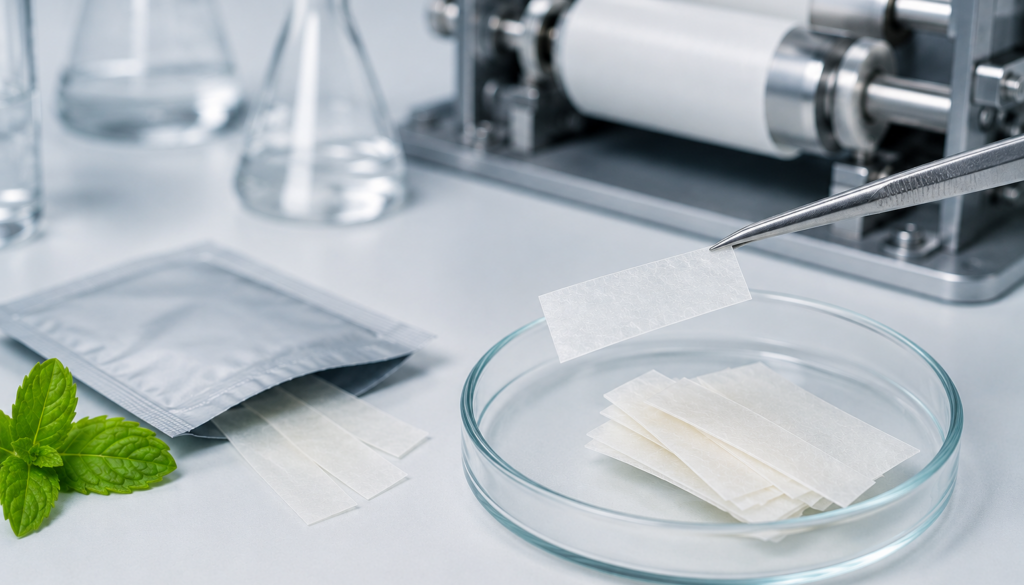
How Oral Thin Films Are Manufactured: 7 Critical Steps From Mixing to Packaging
Oral thin film manufacturing process is a carefully controlled sequence that transforms raw materials into thin, flexible and consistently manufactured oral films. For pharmaceutical, nutraceutical and wellness product teams, understanding the complete process is essential before selecting a manufacturing partner or planning commercial production.
The oral thin film manufacturing process involves much more than simply mixing ingredients and drying them into a strip. Material preparation, polymer hydration, mixing, deaeration, casting, drying, conversion, testing and packaging can all influence the final product.
Poor control at any stage can create serious problems such as thickness variation, bubbles, weak films, tackiness, inconsistent unit mass or stability concerns. A well-designed process, supported by appropriate in-process controls, can help reduce these risks.
What Is the Oral Thin Film Manufacturing Process?
The oral thin film manufacturing process converts a liquid formulation containing film-forming materials and other required ingredients into a controlled thin film.
A common manufacturing approach is solvent casting.
In a typical solvent-casting process, the formulation is prepared as a solution or dispersion, cast as a controlled wet layer, dried, converted into individual films and packaged in a suitable protective format.
The exact process depends on factors including:
- Product formulation
- Ingredient characteristics
- Polymer system
- Target film dimensions
- Film thickness
- Manufacturing equipment
- Drying requirements
- Packaging configuration
- Quality specifications
Because these factors are interconnected, a change in formulation can affect manufacturing behaviour and a change in process conditions can affect product characteristics.
Oral Thin Film Manufacturing Process at a Glance
| Step | Manufacturing Stage | Main Objective | Critical Risk |
|---|---|---|---|
| 1 | Material Preparation | Verify and prepare approved materials | Incorrect material or quantity |
| 2 | Mixing & Polymer Hydration | Create a controlled solution or dispersion | Poor mixing or non-uniformity |
| 3 | Deaeration | Remove entrapped air | Bubbles and voids |
| 4 | Casting | Create a controlled wet film layer | Thickness variation |
| 5 | Drying | Remove solvent under controlled conditions | Over-drying or residual moisture |
| 6 | Conversion & Testing | Cut and evaluate individual films | Unit variation or defects |
| 7 | Packaging | Protect finished films | Moisture, oxygen or seal failure |
Step 1: Material Preparation and Dispensing
The first stage of the oral thin film manufacturing process is controlled material preparation.
Raw materials should be identified, approved and dispensed according to the applicable manufacturing and quality procedures.
Materials may include:
- Film-forming polymers
- Active or functional ingredients
- Plasticisers
- Sweeteners
- Flavours
- Sensory modifiers
- Processing aids
- Other formulation-specific excipients
Accurate dispensing is critical because even a well-designed formula can fail if incorrect materials or quantities enter the batch.
Why Raw-Material Characteristics Matter
The ingredient name alone may not provide enough information.
Manufacturing behaviour can potentially vary according to:
- Material grade
- Salt or chemical form
- Particle characteristics
- Carrier system
- Extract ratio
- Moisture sensitivity
- Solubility
- Supplier specification
These characteristics can influence mixing, viscosity, taste, appearance, drying and film uniformity.
This is why strong raw-material controls are an essential foundation for reliable manufacturing.
Step 2: Mixing and Polymer Hydration
Mixing is one of the most important stages in the oral thin film manufacturing process.
The formulation needs to become a suitable solution or dispersion before it can be cast into a film.
Film-forming polymers may require controlled hydration or dissolution. Other ingredients may then need to be incorporated in a defined order.
Important mixing parameters can include:
- Order of addition
- Mixing speed
- Mixing time
- Temperature
- pH
- Solids content
- Viscosity
- Hold time
The correct parameters depend on the specific formulation and equipment.
Why Order of Addition Is Important
Adding all ingredients at the same time may not produce the desired result.
Some polymers require adequate hydration before other materials are introduced. Certain ingredients can also influence viscosity, pH or polymer behaviour.
A controlled order of addition can therefore improve process consistency.
Poor sequencing can create difficult problems such as incomplete hydration, agglomeration or inconsistent distribution.
Understanding Viscosity
Viscosity is particularly important because the prepared liquid needs to move through the casting system in a controlled manner.
If viscosity is unsuitable, potential problems can include:
- Poor flow
- Uneven casting
- Thickness variation
- Air entrapment
- Difficult processing
The target viscosity should therefore be defined for the specific formulation and process rather than treated as one universal value.
Step 3: Deaeration
After mixing, entrapped air may remain within the solution or dispersion.
This can create serious defects during casting and drying.
Potential problems include:
- Bubbles
- Voids
- Surface defects
- Visual inconsistency
- Thickness variation
Deaeration is therefore an important stage of the oral thin film manufacturing process.
The specific approach depends on the formulation and equipment.
The objective is to reduce unwanted air without negatively affecting the formulation.
Step 4: Precision Casting
Once the formulation is prepared and appropriately deaerated, it can move to the casting stage.
Casting transforms the liquid formulation into a controlled wet web.
This is a critical step because the characteristics of the wet layer influence the properties of the final dried film.
Important variables may include:
- Casting gap
- Feed rate
- Line speed
- Wet-film thickness
- Web width
- Formulation viscosity
- Temperature
- Equipment settings
Small changes in these parameters can influence final film thickness and unit characteristics.
Why Thickness Control Matters
Film thickness can influence:
- Unit mass
- Ingredient distribution
- Mechanical properties
- Drying behaviour
- Disintegration
- Packaging performance
Poor thickness control can therefore create significant downstream quality problems.
Manufacturers may monitor thickness or related in-process parameters at representative positions across the film web.
Step 5: Controlled Drying
Drying is one of the most sensitive stages in the oral thin film manufacturing process.
The objective is to remove the required amount of solvent while maintaining suitable film properties and protecting formulation components.
Drying conditions may influence:
- Residual moisture
- Film flexibility
- Brittleness
- Tackiness
- Mechanical strength
- Flavour retention
- Ingredient stability
- Disintegration characteristics
What Happens If Drying Is Too Aggressive?
Excessive heat or inappropriate drying conditions can potentially create unwanted effects.
Possible risks include:
- Loss of volatile flavour components
- Ingredient degradation
- Excessive brittleness
- Changes in mechanical behaviour
This is why simply increasing temperature to accelerate production can be a dangerous approach.
What Happens If Drying Is Insufficient?
Insufficient drying can also cause problems.
Potential consequences include:
- Excessive residual moisture
- Tackiness
- Difficult handling
- Conversion problems
- Packaging problems
- Stability concerns
The best drying strategy balances manufacturing efficiency with final product requirements.
Why Drying Profiles Matter
Commercial drying may involve multiple controlled zones rather than one fixed condition.
Depending on the equipment and formulation, different stages may be used to manage solvent removal progressively.
Development teams need to understand how the formulation responds to these conditions before establishing a commercial process.
Step 6: Inspection, Slitting, Cutting and Conversion
After drying, the film web moves into conversion.
The objective is to transform the larger web into individual units with defined dimensions.
The conversion process may include:
- Visual inspection
- Slitting
- Cutting
- Unit separation
- Sampling
- Transfer to packaging
This stage needs appropriate controls because inaccurate cutting or web handling can create inconsistent finished units.
What Is Checked During Conversion?
Depending on the product, manufacturers may evaluate:
- Appearance
- Dimensions
- Thickness
- Unit mass
- Cutting accuracy
- Defects
- Yield
Representative sampling can be important because variation may occur at different positions across the web.
Step 7: Protective Packaging
Packaging is the final major stage of the oral thin film manufacturing process, but it should not be considered only after manufacturing is complete.
Oral films may be sensitive to environmental exposure.
Potential risks include:
- Moisture
- Oxygen
- Light
- Temperature
- Physical damage
Appropriate packaging helps maintain the required product characteristics during storage and distribution.
Common Packaging Approaches
Depending on the product, packaging formats may include:
- Individually sealed pouches
- Sachets
- Suitable blister configurations
- Other validated protective systems
The correct format depends on the specific product.
Why Seal Integrity Is Critical
Even a high-barrier packaging material can fail if the finished package is not properly sealed.
Seal performance may depend on:
- Sealing temperature
- Pressure
- Dwell time
- Material compatibility
- Package geometry
- Equipment settings
Poor seals can create serious stability risks even when the packaging material itself has excellent barrier properties.
Critical Process Parameters in Oral Thin Film Manufacturing
The oral thin film manufacturing process requires control of multiple variables.
| Process Area | Parameters That May Require Control |
|---|---|
| Raw Materials | Identity, grade, quantity, storage |
| Mixing | Speed, time, order of addition |
| Solution/Dispersion | pH, viscosity, solids content |
| Deaeration | Air removal conditions |
| Casting | Gap, feed rate, line speed, wet thickness |
| Drying | Temperature, airflow, residence time |
| Conversion | Dimensions, cutting accuracy, yield |
| Packaging | Seal conditions, integrity, barrier performance |
Not every parameter is equally critical for every product. The final control strategy should be based on the specific formulation, process and product requirements.
In-Process Controls During Manufacturing
In-process controls help manufacturers identify problems before the complete batch reaches finished-product testing.
Depending on the product, monitoring may include:
- Appearance
- Solution or dispersion characteristics
- pH
- Viscosity
- Wet-film characteristics
- Thickness
- Unit dimensions
- Unit mass
- Moisture-related parameters
- Packaging integrity
Effective in-process control can provide an important advantage by detecting process drift early.
Waiting until final testing to identify every problem can result in avoidable waste, delays and investigation.
Quality Testing for Finished Oral Thin Films
Finished-product testing depends on the intended product and destination market.
Potential tests may include:
| Quality Attribute | Purpose |
|---|---|
| Appearance | Evaluate visible film quality |
| Dimensions | Confirm physical size |
| Thickness | Assess film consistency |
| Unit Mass | Monitor unit-to-unit consistency |
| Identity | Confirm intended ingredient identity |
| Assay | Determine ingredient content |
| Content Uniformity | Evaluate distribution between units |
| Disintegration | Assess film breakdown behaviour |
| Dissolution/Release | Evaluate release characteristics where applicable |
| Moisture | Monitor moisture-related properties |
| Impurities | Evaluate degradation or related substances where applicable |
| Microbial Quality | Evaluate microbiological attributes |
| Package Integrity | Confirm packaging protection |
A major mistake is assuming that every oral film requires exactly the same specification.
Testing should be selected according to the product and its requirements.
Content Uniformity: Why Distribution Matters
Uniformity is a critical consideration because the film needs appropriate ingredient distribution.
Potential causes of poor uniformity may include:
- Inadequate mixing
- Sedimentation
- Agglomeration
- Casting variation
- Thickness variation
- Conversion inconsistencies
This is why the oral thin film manufacturing process needs to be viewed as one connected system.
A problem discovered during finished-product testing may have originated much earlier during mixing or casting.
Scale-Up: From Laboratory Film to Commercial Production
One of the most costly mistakes in oral-film development is assuming that a successful laboratory film can move directly to commercial manufacturing without additional process work.
Laboratory and commercial equipment can differ substantially.
Scale-up differences may involve:
- Mixing geometry
- Batch volume
- Shear
- Hold times
- Casting width
- Drying capacity
- Airflow
- Line speed
- Web handling
- Packaging speed
A formulation that performs well on a small development setup may behave differently at commercial scale.
Pilot manufacturing can therefore provide valuable information before routine production.
Why Mixing Does Not Scale by Volume Alone
Increasing a laboratory formula from a small batch to a large commercial batch is not simply a mathematical multiplication exercise.
Larger equipment changes fluid movement, mixing energy, heat transfer and processing time.
Manufacturers may therefore need to evaluate:
- Impeller design
- Mixing speed
- Mixing duration
- Addition sequence
- Temperature control
- Batch homogeneity
Ignoring these differences can result in poor and inconsistent manufacturing performance.
Why Drying Becomes More Challenging at Scale
Commercial drying equipment can introduce different thermal and airflow conditions from laboratory equipment.
The manufacturer needs to establish conditions that provide sufficient drying without damaging the product.
This may require evaluation of:
- Zone temperatures
- Airflow
- Residence time
- Line speed
- Wet-film thickness
A robust commercial process balances all of these factors rather than optimizing only one variable.
Common Oral Thin Film Manufacturing Problems
Even promising formulations can encounter manufacturing challenges.
Problem 1: Bubbles
Possible contributing factors can include air introduced during mixing or insufficient deaeration.
Problem 2: Uneven Thickness
Potential causes may involve viscosity variation, casting settings, feed inconsistency or web-related factors.
Problem 3: Brittle Films
Brittleness may be influenced by formulation composition, moisture content or drying conditions.
Problem 4: Tackiness
Tackiness can be associated with formulation characteristics, moisture or insufficient drying.
Problem 5: Poor Ingredient Uniformity
Potential causes include inadequate mixing, settling, agglomeration or inconsistent film thickness.
Problem 6: Cutting Problems
Films with unsuitable mechanical properties may be difficult to convert consistently.
Problem 7: Packaging Failure
Incorrect sealing conditions or unsuitable materials can compromise product protection.
Identifying the root cause is more effective than treating only the visible defect.
How Packaging Connects to Stability
The oral thin film manufacturing process does not truly end when the film leaves the drying equipment.
Packaging needs to maintain the product characteristics achieved during manufacturing.
Moisture changes can potentially affect:
- Flexibility
- Brittleness
- Tack
- Mechanical properties
- Disintegration
- Flavour
- Ingredient stability
Oxygen and light may also affect sensitive ingredients.
For this reason, packaging and stability evaluation should be connected to formulation and manufacturing development.
10 Critical Questions to Ask an Oral Thin Film Manufacturer
Before selecting a manufacturing partner, ask:
- Which oral-film manufacturing processes are available?
- How is ingredient and polymer feasibility evaluated?
- Which parameters are monitored during mixing?
- How is deaeration controlled?
- How is film thickness controlled during casting?
- How are drying conditions established?
- How is scale-up from development to commercial production managed?
- Which in-process and finished-product tests are available?
- How are packaging materials and seal conditions evaluated?
- How are deviations and process changes documented?
Clear answers can help buyers understand whether a manufacturer has a structured development and manufacturing approach.
Positive Signs of a Strong Manufacturing Partner
A strong oral-film manufacturer should demonstrate:
- Clear technical evaluation
- Defined process controls
- Appropriate quality systems
- Structured scale-up planning
- Product-specific testing
- Packaging knowledge
- Transparent communication
- Realistic commercial expectations
Another positive sign is willingness to identify technical uncertainty rather than making unrealistic promises.
Serious Red Flags to Avoid
Brands should be cautious when a supplier:
- Guarantees manufacturing success without reviewing the formulation
- Promises unrealistic commercial timelines
- Cannot explain key process controls
- Provides no clear scale-up strategy
- Treats packaging as an unrelated final step
- Guarantees shelf life without supporting stability evidence
- Cannot define product specifications
- Provides unclear quality documentation
- Makes performance promises before technical evaluation
These dangerous red flags can indicate unnecessary technical and commercial risk.
How to Prepare a Manufacturing Brief
Before discussing the oral thin film manufacturing process with a potential partner, prepare a decision-ready brief.
Include:
- Destination market
- Intended product category
- Ingredient names
- Ingredient forms
- Target amount per film
- Proposed claims
- Film dimensions
- Flavour requirements
- Sensory expectations
- Packaging requirements
- Initial commercial quantity
- Annual forecast
- Documentation requirements
- Target launch timing
A clear brief allows the manufacturer to assess the project more effectively.
Frequently Asked Questions About the Oral Thin Film Manufacturing Process
What is the oral thin film manufacturing process?
The oral thin film manufacturing process typically involves material preparation, mixing, polymer hydration, deaeration, casting, controlled drying, conversion, testing and protective packaging.
What is solvent casting in oral thin film manufacturing?
Solvent casting involves preparing a polymer-based solution or dispersion, applying it as a controlled wet layer and drying it to create a thin film.
Why is deaeration important?
Entrapped air can create bubbles, voids, visual defects and thickness inconsistencies. Deaeration helps reduce these potential problems before casting.
Why is viscosity important in oral thin film manufacturing?
Viscosity can influence flow, casting behaviour, film thickness and overall process consistency. The appropriate range depends on the formulation and equipment.
Why is drying critical for oral thin films?
Drying affects residual moisture, flexibility, tackiness, mechanical properties and potentially ingredient or flavour stability. Both excessive and insufficient drying can create problems.
How are oral thin films cut into individual units?
After drying, the film web can be inspected, slit and cut into defined unit dimensions before packaging.
Why is packaging important for oral thin films?
Suitable packaging helps protect films from environmental factors such as moisture, oxygen, light and physical handling.
Can a laboratory oral film be manufactured commercially without scale-up?
Not necessarily. Commercial equipment introduces differences in mixing, casting, drying and web handling. Pilot and scale-up work may be required.
Build a Reliable Oral Thin Film Manufacturing Process
A successful oral thin film manufacturing process requires much more than creating a thin strip. Each stage—from material preparation and mixing to casting, drying, conversion and packaging—needs to function as part of a controlled product system.
Strong process development can help identify risks before they become expensive commercial problems. Appropriate in-process controls, finished-product testing, scale-up planning and packaging evaluation can support a more reliable manufacturing pathway.
Lagom Life Sciences reviews qualified oral-film projects across development, technology-transfer and contract-manufacturing pathways. Manufacturing feasibility, process parameters, testing, stability, packaging and commercial supply should be confirmed through project-specific technical and quality review.
Ready to discuss your oral thin film manufacturing process? Request a manufacturing discussion with Lagom Life Sciences.