CDMO in Pharma: Development, Manufacturing, Quality and Oral Strip Solutions
The pharmaceutical industry requires specialised knowledge, reliable manufacturing processes and effective quality management to transform product concepts into market-ready products. Businesses developing pharmaceutical, nutraceutical and wellness products often need support across formulation, process development, manufacturing, testing and packaging. This is where CDMO in pharma becomes an important consideration.
A Contract Development and Manufacturing Organization (CDMO) provides development and manufacturing services to pharmaceutical and related businesses. Depending on the provider, these services can include formulation research, process optimisation, pilot production, commercial manufacturing, quality assurance and packaging support.
For companies exploring specialised dosage forms such as oral dissolving strips, selecting a suitable development and manufacturing partner is particularly important. Formulation characteristics, ingredient compatibility, processing conditions, moisture management and packaging all influence the finished product.
This guide explains CDMO in pharma, its key services, the role of oral strip technology, quality requirements, manufacturing scale-up and the factors businesses should consider when selecting a suitable partner.
What Is CDMO in Pharma?
CDMO in pharma refers to contract development and manufacturing services for pharmaceutical products. A Contract Development and Manufacturing Organization works with product owners to support some or all stages of product development and production.
Unlike a manufacturer that focuses primarily on producing an established formulation, a CDMO may also provide technical development support before commercial manufacturing begins. The actual scope depends on the organisation’s expertise, facilities and service offering.
Typical activities may include:
- Pharmaceutical formulation development.
- Research and development support.
- Process development and optimisation.
- Pilot batch manufacturing.
- Commercial production.
- Quality control and quality assurance.
- Packaging and stability support.
- Technology transfer and scale-up.
The main objective of CDMO in pharma is to help businesses access appropriate development and manufacturing capabilities through an outsourced partnership.
However, not every CDMO provides every service. Businesses should verify a provider’s current capabilities, regulatory suitability and experience with the specific product before beginning a project.
Why CDMO in Pharma Matters for Pharmaceutical Businesses
Developing a pharmaceutical product requires coordination between formulation, manufacturing, quality, packaging and regulatory functions. Managing all these activities internally can require substantial resources.
CDMO in pharma provides an outsourcing model through which businesses may access specialised expertise and existing manufacturing infrastructure.
1. Access to Specialised Expertise
Pharmaceutical formulation and manufacturing require knowledge of ingredients, processing conditions, product performance and quality requirements.
A suitable CDMO may provide access to technical teams experienced in the relevant dosage form and manufacturing process. This can be particularly valuable when developing specialised products that require additional formulation or process optimisation.
Businesses should confirm that the provider has relevant experience rather than assuming that general pharmaceutical manufacturing experience covers every technology.
2. Integrated Product Development
In CDMO in pharma projects, formulation and manufacturing decisions are closely connected. An ingredient change may affect product stability, processing conditions or finished-product performance.
An integrated development approach can help identify these relationships early and establish a clearer path from laboratory development to pilot production.
The development programme should include defined milestones, testing requirements, acceptance criteria and documented technical decisions.
3. Access to Manufacturing Infrastructure
Building a pharmaceutical manufacturing facility requires investment in equipment, infrastructure, trained personnel, maintenance and quality systems.
Working with an established CDMO may provide access to appropriate infrastructure without requiring a business to establish every manufacturing capability internally.
The financial and operational benefits depend on the project scope, production volume, minimum order quantities and commercial agreement.
4. Support for Production Scale-Up
A formulation that works in a laboratory may behave differently when transferred to larger equipment.
CDMO in pharma can involve evaluating process parameters, equipment suitability and manufacturing consistency as production increases. Pilot batches can help identify potential challenges before commercial manufacturing begins.
Scale-up capability should be confirmed for the specific product and manufacturing technology.
5. Focus on Core Business Activities
Outsourcing suitable development and production activities can allow businesses to concentrate on product strategy, marketing, distribution and customer relationships.
However, outsourcing does not remove the need for appropriate oversight. Product owners and manufacturing partners should agree on responsibilities for specifications, documentation, quality, regulatory activities and changes.
Key Services Included in CDMO in Pharma
CDMO services vary between organisations. Understanding the available services helps businesses select a partner whose capabilities match their requirements.
Research and Development
Research and development may include product feasibility assessment, ingredient evaluation, formulation trials and prototype preparation.
The process starts with a target product profile that defines the intended application, active ingredient, target strength, dosage form, performance requirements and target market.
A structured R&D programme helps identify technical challenges and determine which experiments are necessary before proceeding to manufacturing.
When evaluating CDMO in pharma, businesses should ask what development activities are included, what deliverables will be provided and who owns the resulting formulation and technical data.
Formulation Development
Formulation development focuses on creating a product that meets the required physical, chemical and performance characteristics.
Depending on the dosage form, important considerations may include ingredient compatibility, solubility, stability, taste, texture, dose uniformity and processing behaviour.
For oral dissolving strips, formulation development also considers film-forming materials, plasticisers, ingredient loading, flexibility, moisture sensitivity and disintegration behaviour.
A suitable formulation must be evaluated through appropriate testing. The performance of one formulation cannot automatically be assumed for another product.
Process Development and Optimisation
Process development establishes how a formulation can be manufactured consistently.
Depending on the product, process parameters may include mixing conditions, processing time, temperature, coating thickness, drying conditions and cutting accuracy.
The development team evaluates how changes in these parameters affect the finished product and establishes suitable operating ranges.
For CDMO in pharma projects, documented process development supports reproducibility and can help identify the information required for scale-up.
Pilot Manufacturing
Pilot manufacturing provides an opportunity to assess a product and process at a scale larger than laboratory experiments.
Pilot batches can help evaluate equipment suitability, process consistency, material losses, handling characteristics and testing requirements.
The purpose of pilot manufacturing is to generate information that supports technical decisions before larger-scale production.
Businesses should clarify whether pilot manufacturing, sample evaluation and related testing are available through the proposed CDMO.
Commercial Manufacturing
Commercial manufacturing involves producing batches using an established process and appropriate quality controls.
Before production begins, the parties should agree on product specifications, batch sizes, raw material responsibilities, manufacturing schedules, documentation and release requirements.
The manufacturing arrangement should also define how deviations, investigations, process changes and customer complaints will be managed.
Quality Assurance and Quality Control
Quality assurance establishes and oversees the systems used to maintain product quality. Quality control evaluates whether materials and finished products meet their approved specifications.
Depending on the product, relevant activities may include ingredient identification, content testing, uniformity assessment, physical testing, stability studies and batch documentation.
Quality requirements should be based on the product category, intended market and applicable regulatory framework.
Oral Dissolving Strips in CDMO in Pharma
Oral dissolving strips are thin film-based dosage forms designed to dissolve or disintegrate in the mouth under specified conditions.
These products may be explored for selected pharmaceutical, nutraceutical and wellness applications. Their suitability depends on the active ingredient or nutritional component, required dose, formulation characteristics and intended use.
For businesses considering oral dissolving strips, CDMO in pharma involves evaluating the entire product development process rather than simply producing a thin film.
Formulation Considerations
Film-forming polymers provide the structure of the strip, while plasticisers may help control flexibility and mechanical properties.
Other ingredients may be included to support product performance, taste or processing, depending on their suitability for the intended application.
Ingredient compatibility and dose loading require careful evaluation because they can influence film formation, thickness, flexibility and uniformity.
Manufacturing Process
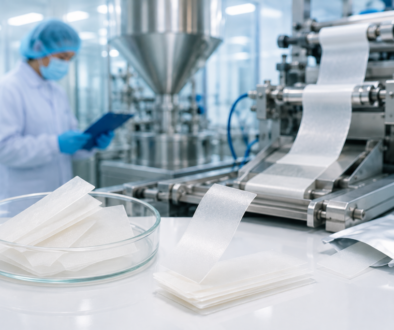
Oral dissolving strips may be manufactured through controlled formulation preparation, mixing, casting or coating, drying, cutting and packaging.
Each stage can influence the quality of the final strip. Inconsistent coating may affect thickness, while unsuitable drying conditions may influence residual moisture and handling properties.
The process must be developed for the specific formulation and equipment rather than copied from a generic manufacturing procedure.
Quality Testing
Quality testing should be selected according to the product’s intended specifications and regulatory requirements.
Potential attributes include appearance, dimensions, weight, ingredient content, content uniformity, moisture, mechanical properties, disintegration or dissolution performance and stability.
Not every test applies to every product. The development team should establish a suitable testing programme for the specific formulation.
Packaging Requirements
Packaging is particularly important when the finished film is sensitive to moisture or other environmental conditions.
Packaging materials, barrier properties, seal integrity, storage conditions and shelf-life requirements should be evaluated together.
A CDMO in pharma project should address packaging early enough to identify potential compatibility or stability issues before commercial production.
Quality Assurance and Regulatory Planning
Quality and regulatory planning are essential components of pharmaceutical development and manufacturing.
Requirements differ according to the product category, manufacturing location and intended market. Pharmaceutical products and nutraceutical products may be subject to different regulatory frameworks.
Before engaging a CDMO, businesses should establish which requirements apply and confirm that the proposed manufacturing arrangement is appropriate.
Important quality considerations include:
- Raw material specifications and supplier qualification.
- Documented manufacturing procedures.
- In-process monitoring and finished-product testing.
- Batch records and material traceability.
- Deviation investigations and corrective actions.
- Change control and document management.
- Stability studies and appropriate storage conditions.
- Defined responsibilities for product release and complaints.
Businesses should verify relevant licences, certifications and facility capabilities directly. General statements about compliance should not be treated as proof that a facility is suitable for every product or market.
A written quality agreement can clarify the responsibilities of the product owner and manufacturing partner throughout development and production.
Technology, Automation and Manufacturing Consistency
Technology and automation may support process control, production monitoring and documentation in pharmaceutical manufacturing.
The benefits depend on the equipment, process design and quality systems in place. Automation alone does not guarantee product consistency or regulatory compliance.
For CDMO in pharma, businesses should evaluate whether the available technology is appropriate for the required dosage form and production volume.
For oral dissolving strips, relevant equipment may support controlled coating, drying, film handling, cutting and packaging. Process monitoring can help identify variation, but the required controls must be established through product-specific development.
When reviewing a provider, ask about equipment suitability, process monitoring, maintenance, documentation and how manufacturing changes are assessed.
Scale-Up and Commercial Manufacturing
Scale-up is the transition from development activities to manufacturing at a larger production volume.
Differences in equipment size, mixing behaviour, processing speed, drying capacity and material handling can affect product quality. These differences should be assessed before routine commercial production.
A structured CDMO in pharma scale-up plan may include:
- Reviewing development data and formulation specifications.
- Identifying important process parameters and quality attributes.
- Assessing equipment and facility suitability.
- Planning and evaluating pilot batches.
- Reviewing process consistency and test results.
- Establishing documented manufacturing procedures.
- Confirming packaging and stability requirements.
Technology transfer should include the technical information necessary to reproduce the process in the intended manufacturing environment.
Businesses should also consider production capacity, raw material availability, lead times and expected future demand when selecting a manufacturing partner.
How to Select the Right CDMO in Pharma
Choosing the right partner requires an assessment of technical, operational, quality and commercial factors.
Evaluate Relevant Experience
Review the provider’s experience with the required product category, dosage form and manufacturing technology.
For specialised oral films, confirm that the organisation can support the relevant formulation and processing requirements.
Review Development Capabilities
Ask whether the provider offers feasibility assessment, formulation development, pilot batches, process optimisation and scale-up support.
Confirm which activities are included in the proposed scope and which may incur additional charges.
Assess Quality Systems
Review the relevant quality documentation, testing capabilities, material controls, deviation management and change control procedures.
Verify applicable licences and certifications for the proposed facility and product category.
Confirm Manufacturing Capacity
Discuss batch sizes, production schedules, minimum order quantities and the ability to support future demand.
A provider’s available capacity should be suitable for both the current project and anticipated production requirements.
Compare Commercial Terms
Evaluate development charges, raw material costs, manufacturing prices, testing, packaging, lead times and payment terms.
The lowest quotation is not necessarily the most suitable option if it excludes important technical or quality activities.
Establish Clear Communication
Agree on milestones, responsibilities, sample approvals, reporting, documentation and escalation procedures.
Clear communication can help manage changes and keep the development programme aligned with business objectives.
CDMO in Pharma: Considering Lagom Life Sciences
Lagom Life Sciences states on its website that it focuses on orally dissolving strips and applications across pharmaceutical, nutraceutical and wellness categories. Its website also highlights research and development, quality assurance, manufacturing, technology, automation and scalable oral-strip production.
For businesses researching CDMO in pharma, Lagom Life Sciences may be worth evaluating when exploring oral dissolving strip development and manufacturing.
The suitability of a provider depends on the specific product and its technical requirements. Companies should confirm the current service offering, relevant facility capabilities, certifications, regulatory status, minimum order quantities and commercial terms directly with Lagom Life Sciences.
Preparing for a Technical Discussion
Businesses can make the initial discussion more productive by preparing a clear product brief.
Include the following information:
- Active ingredient or nutritional component.
- Target strength and intended application.
- Proposed dosage form and strip dimensions.
- Desired flavour and relevant physical characteristics.
- Packaging preferences and storage requirements.
- Intended market and applicable regulatory considerations.
- Estimated development quantities and commercial production volume.
This information can help establish whether the proposed product is technically feasible and identify the development work, testing and manufacturing steps that may be required.
For a CDMO in pharma project, a documented scope should also clarify formulation ownership, confidentiality, development data, change control and responsibilities for product quality.
Common Challenges in Pharmaceutical Contract Development and Manufacturing
Businesses should consider potential challenges before beginning a CDMO project.
Formulation feasibility: Some ingredients or dose requirements may not be suitable for the proposed dosage form.
Scale-up variation: A process may need further optimisation when transferred from laboratory equipment to commercial manufacturing.
Packaging and stability: Product characteristics may change under unsuitable storage conditions or when packaging does not provide adequate protection.
Regulatory complexity: Requirements depend on product classification and the intended market.
Supply chain interruptions: Raw material shortages or packaging delays can affect production schedules.
Unclear responsibilities: Missing agreements about quality, changes, data ownership or release procedures can create avoidable disputes.
Early technical assessment, documented procedures and clear communication can help businesses manage these risks.
Frequently Asked Questions About CDMO in Pharma
What does CDMO in pharma mean?
CDMO in pharma refers to Contract Development and Manufacturing Organization services for pharmaceutical products. These services may combine product development with manufacturing, depending on the provider.
What services does a pharmaceutical CDMO offer?
Services may include research and development, formulation development, process optimisation, pilot manufacturing, commercial production, quality assurance, testing, packaging and technology transfer.
What is the difference between a CDMO and a CMO?
A Contract Manufacturing Organization (CMO) primarily focuses on manufacturing, while a CDMO generally offers both development and manufacturing services. Actual service scopes can overlap and should be confirmed with the provider.
Can CDMO in pharma support oral dissolving strips?
Some CDMOs have relevant oral film development and manufacturing capabilities. Suitability depends on the ingredient, target dose, formulation, equipment, testing requirements and intended market.
Why is quality assurance important in CDMO in pharma?
Quality assurance helps ensure that manufacturing activities, documentation, testing and change management follow established procedures and applicable requirements.
What should businesses consider before choosing a CDMO?
Businesses should evaluate relevant technical experience, formulation capabilities, manufacturing capacity, quality systems, regulatory suitability, packaging, scalability, costs and communication.
How does pharmaceutical manufacturing scale-up work?
Scale-up involves transferring a process from development or pilot conditions to larger-scale production while assessing equipment suitability, process parameters, quality attributes and reproducibility.
How can a company begin an oral dissolving strip project?
Prepare a product brief covering the ingredient, target strength, intended use, strip characteristics, packaging, target market and expected production volume. A technical feasibility discussion can then establish the next steps.
Conclusion
CDMO in pharma plays an important role in connecting pharmaceutical product development with manufacturing, quality assurance, packaging and commercial production.
Businesses should evaluate potential partners based on their relevant technical expertise, development capabilities, manufacturing infrastructure, quality systems, scalability and commercial terms. For specialised dosage forms such as oral dissolving strips, formulation feasibility, process consistency, moisture management and packaging require particular attention.
Lagom Life Sciences states that it focuses on orally dissolving strips and highlights pharmaceutical, nutraceutical and wellness applications, along with research and development, quality assurance, manufacturing, technology and automation. Companies considering Lagom should confirm its current capabilities and project-specific suitability directly.
A clear target product profile, documented development plan and well-defined responsibilities can help businesses assess their options and establish a practical path from initial development to potential commercial manufacturing.