Pharmaceutical Formulation Development Services: From Concept to Commercial Production
The pharmaceutical industry is continuously evolving with the introduction of innovative drug delivery technologies, advanced formulations, and changing healthcare requirements. Pharmaceutical companies must develop products that meet quality expectations, maintain stability, deliver consistent performance, and satisfy applicable regulatory requirements. This makes formulation development an important part of pharmaceutical product innovation.
Pharmaceutical Formulation Development Services help pharmaceutical companies transform an active pharmaceutical ingredient (API) or product concept into a suitable pharmaceutical dosage form. These services involve selecting excipients, developing formulations, evaluating compatibility, optimising manufacturing processes, and assessing product quality.
For pharmaceutical manufacturers, nutraceutical brands, and healthcare businesses, choosing the right formulation development partner can make a significant difference in product development timelines and manufacturing readiness.
Professional Pharmaceutical Formulation Development Services support businesses throughout different stages of product development. Whether a company is developing tablets, capsules, oral liquids, or oral dissolving films, a structured formulation strategy helps establish product consistency and manufacturing feasibility.
Lagom Life Sciences operates in the pharmaceutical and oral film technology space. Businesses exploring Pharmaceutical Formulation Development Services can benefit from understanding the technical requirements, development stages, and factors involved in selecting a suitable development partner.
What Are Pharmaceutical Formulation Development Services?
Pharmaceutical Formulation Development Services refer to the scientific and technical activities involved in designing, developing, evaluating, and optimising pharmaceutical products.
A pharmaceutical formulation combines an active pharmaceutical ingredient with suitable excipients to create a dosage form that meets its intended performance, quality, and stability requirements.
The development process considers several important factors, including:
-
API characteristics and compatibility.
-
Selection of suitable excipients.
-
Drug release and dissolution characteristics.
-
Physical and chemical stability.
-
Manufacturing feasibility.
-
Quality control requirements.
-
Packaging compatibility.
Pharmaceutical Formulation Development Services help businesses evaluate these factors before moving towards commercial manufacturing.
For example, a pharmaceutical company planning to introduce an oral dissolving film must consider film-forming polymers, plasticisers, taste-masking agents, API compatibility, moisture sensitivity, and dissolution characteristics.
Similarly, tablet and capsule development requires appropriate excipient selection, powder characteristics, compression properties, and dosage uniformity.
A reliable formulation development strategy helps pharmaceutical businesses reduce unnecessary development challenges and establish a more structured product development process.
Why Pharmaceutical Companies Need Formulation Development
Developing a pharmaceutical product involves much more than combining ingredients. Every formulation must be designed according to the characteristics of its API, intended dosage form, and quality requirements.
Pharmaceutical Formulation Development Services are valuable because they help businesses address technical challenges during product development.
Key reasons include:
A. Product Innovation
Companies can explore new dosage forms, improve existing formulations, and develop products that address specific market requirements.
B. Improved Formulation Performance
Appropriate excipient selection and formulation optimisation can help achieve the intended product characteristics.
C. Manufacturing Feasibility
A formulation that performs well in laboratory conditions must also be evaluated for its ability to be manufactured consistently at a larger scale.
D. Product Stability
Stability studies help assess how environmental conditions such as temperature, humidity, and light affect product quality over time.
E. Quality Consistency
Defined formulation parameters and appropriate testing procedures support consistent product quality across manufacturing batches.
Pharmaceutical Formulation Development Services provide a structured approach to addressing these requirements.
Major Stages of Pharmaceutical Formulation Development Services
A systematic development process helps businesses move from an initial product concept towards a manufacturing-ready formulation.
Stage 1: Product Requirement Analysis
The first stage involves understanding the product concept and business requirements.
Development teams evaluate:
-
Intended therapeutic or nutritional application.
-
API characteristics.
-
Desired dosage form.
-
Target product profile.
-
Manufacturing requirements.
-
Applicable regulatory considerations.
This stage establishes the foundation for Pharmaceutical Formulation Development Services and helps define the development objectives.
Stage 2: Preformulation Studies
Preformulation studies evaluate the physical and chemical properties of the API before formulation development begins.
Important evaluation parameters include:
-
Solubility.
-
Particle size.
-
Moisture sensitivity.
-
Melting point.
-
Polymorphic characteristics.
-
Excipient compatibility.
-
Chemical stability.
These investigations help identify potential formulation challenges and guide the selection of suitable ingredients.
Stage 3: Excipient Selection
Excipients play an important role in pharmaceutical product development.
Depending on the dosage form, formulation developers may evaluate:
-
Binders.
-
Fillers.
-
Disintegrants.
-
Stabilising agents.
-
Preservatives.
-
Sweeteners.
-
Flavouring agents.
-
Film-forming polymers.
-
Plasticisers.
The selection depends on API characteristics, dosage form requirements, and intended product performance.
Stage 4: Prototype Formulation Development
During this stage, different formulation combinations are prepared and evaluated.
The development team may prepare multiple prototypes with varying ingredient concentrations and processing conditions.
The objective is to identify a formulation that meets the defined product requirements.
Stage 5: Formulation Optimisation
After initial prototypes are evaluated, formulation parameters may be adjusted to improve product characteristics.
Depending on the dosage form, optimisation may include:
-
Ingredient concentration.
-
Mixing conditions.
-
Processing temperature.
-
Drying conditions.
-
Viscosity.
-
Dissolution characteristics.
-
Physical appearance.
Pharmaceutical Formulation Development Services use these evaluations to establish a more suitable formulation for further development.
Stage 6: Quality Evaluation
Quality evaluation helps determine whether the developed formulation meets its predefined specifications.
Testing requirements depend on the product and dosage form.
Examples include:
-
Appearance.
-
Assay.
-
Content uniformity.
-
Dissolution.
-
Disintegration.
-
Moisture content.
-
Microbial quality, where applicable.
-
Physical and chemical stability.
Stage 7: Scale-Up and Manufacturing Readiness
A formulation developed at laboratory scale must be assessed before larger-scale production.
Scale-up activities evaluate whether the formulation and process can be transferred to suitable manufacturing equipment while maintaining critical quality attributes.
Pharmaceutical Formulation Development Services can support this transition through process evaluation, documentation, and manufacturing feasibility assessments.
Types of Pharmaceutical Formulations
Different pharmaceutical products require different formulation approaches. The selection depends on API properties, patient requirements, product specifications, and manufacturing capabilities.
Common dosage forms
| Dosage Form | Main Characteristics | Development Considerations |
|---|---|---|
| Tablets | Solid oral dosage form | Compression, disintegration and dissolution |
| Capsules | Solid dosage form with shell | Fill compatibility and content uniformity |
| Oral Liquids | Liquid pharmaceutical preparations | Solubility, viscosity and stability |
| Oral Suspensions | Dispersed solid particles in liquid | Particle distribution and physical stability |
| Oral Dissolving Films | Thin films designed to dissolve in the mouth | Polymer selection, moisture and dissolution |
| Topical Formulations | Products applied to the skin | Consistency, stability and ingredient compatibility |
Pharmaceutical Formulation Development Services help determine the appropriate development approach for each dosage form.
Why Oral Dissolving Films Are an Important Development Area
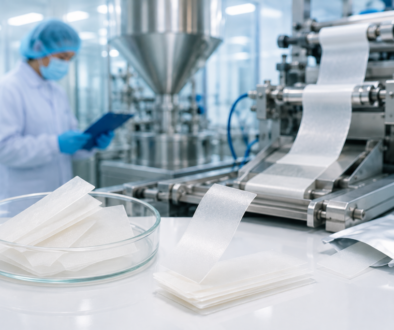
Oral dissolving films are an innovative dosage form designed to dissolve in the oral cavity.
They generally consist of film-forming polymers, plasticisers, active ingredients, and other suitable excipients.
Their development involves specific technical considerations, such as:
-
Polymer selection.
-
Film flexibility.
-
Uniform API distribution.
-
Taste masking.
-
Disintegration time.
-
Moisture protection.
-
Packaging compatibility.
For companies exploring innovative oral dosage technologies, Pharmaceutical Formulation Development Services involving oral film development can provide opportunities to evaluate alternative product formats.
Benefits of Choosing Professional Pharmaceutical Formulation Development Services
Working with an experienced development partner can help pharmaceutical businesses organise their product development activities more efficiently.
Major benefits
1. Technical Expertise
Specialised development teams understand API properties, excipient functionality, and dosage form requirements.
2. Structured Product Development
A defined development approach helps businesses progress through preformulation, prototype development, optimisation, and evaluation.
3. Better Manufacturing Feasibility
Evaluating manufacturing requirements during development can help identify potential scale-up challenges.
4. Quality-Focused Development
Appropriate testing and documentation support the evaluation of product quality.
5. Support for New Product Development
Businesses can explore new dosage forms and formulation concepts based on their product requirements.
6. Improved Development Planning
Defined development milestones help businesses organise technical activities, testing, and manufacturing preparation.
Pharmaceutical Formulation Development Services can therefore become an important component of a pharmaceutical company’s product development strategy.
How to Choose the Right Pharmaceutical Formulation Development Partner
Selecting a development partner is an important business decision. Pharmaceutical companies should assess the technical capabilities and development approach of potential service providers.
Consider the following factors:
1. Formulation Development Experience
Review the company’s experience with relevant dosage forms and product categories.
2. Technical Infrastructure
Evaluate whether the development partner has suitable laboratory facilities, equipment, and testing capabilities.
3. Dosage Form Expertise
Different dosage forms require different technical knowledge. Companies developing oral films, for example, should evaluate the partner’s experience with film formulation and manufacturing processes.
4. Quality Management Practices
Understand how the organisation approaches quality evaluation, documentation, and process controls.
5. Scale-Up Capabilities
Determine whether the partner can support the transition from laboratory development to larger-scale manufacturing.
6. Communication and Project Management
Clear communication, defined project milestones, and transparent technical discussions are important for successful collaboration.
7. Regulatory Understanding
Evaluate the partner’s understanding of applicable pharmaceutical regulations and documentation requirements in the intended markets.
A careful evaluation of these factors can help businesses identify suitable Pharmaceutical Formulation Development Services for their product development objectives.
Pharmaceutical Formulation Development Services vs Contract Manufacturing
Although formulation development and contract manufacturing are closely related, they serve different purposes.
| Parameter | Formulation Development | Contract Manufacturing |
|---|---|---|
| Primary Objective | Develop and optimise a formulation | Manufacture pharmaceutical products |
| Main Activities | Preformulation, excipient selection, prototype development | Production, processing and packaging |
| Focus | Product design and technical evaluation | Manufacturing execution |
| Development Stage | Early and intermediate product development | Manufacturing and commercial supply |
| Key Output | Evaluated formulation and development data | Manufactured product batches |
| Business Requirement | Product innovation and formulation improvement | Production capacity and supply support |
Some pharmaceutical partners may offer both development and manufacturing capabilities. However, the actual scope should always be confirmed before entering into a business agreement.
Pharmaceutical Formulation Development Services can help businesses establish a suitable product design before manufacturing activities begin.
Important Factors Affecting Formulation Development Costs
The cost of pharmaceutical product development varies according to the technical complexity and project requirements.
There is no single development cost applicable to every pharmaceutical formulation.
Important factors include:
-
API cost and availability.
-
Formulation complexity.
-
Number of prototype batches.
-
Excipient selection.
-
Laboratory testing requirements.
-
Stability study requirements.
-
Dosage form.
-
Packaging evaluation.
-
Scale-up requirements.
-
Documentation and regulatory support.
For example, developing a conventional tablet may involve different technical requirements compared with developing an oral dissolving film.
Pharmaceutical Formulation Development Services should therefore be evaluated based on the complete project scope rather than price alone.
Before starting a project, businesses should request a detailed proposal covering development activities, deliverables, timelines, testing requirements, and commercial terms.
The Role of Quality and Stability Testing
Quality and stability are important considerations throughout pharmaceutical product development.
A formulation must be evaluated to determine whether it maintains its specified characteristics under defined conditions.
Important quality evaluation parameters
-
Appearance and physical characteristics.
-
Assay and content uniformity.
-
Dissolution or disintegration.
-
Moisture content.
-
pH, where applicable.
-
Microbiological quality, where applicable.
-
Packaging compatibility.
-
Stability under specified storage conditions.
Stability studies help evaluate potential changes in product quality over time.
For moisture-sensitive products such as oral dissolving films, packaging selection and humidity control may be particularly important.
Pharmaceutical Formulation Development Services should incorporate suitable quality assessments based on the product’s intended use, dosage form, and applicable regulatory expectations.
Future Trends in Pharmaceutical Formulation Development
Pharmaceutical product development continues to evolve as companies explore new delivery systems, patient-focused dosage forms, and manufacturing technologies.
Some important areas of development include:
A. Advanced Drug Delivery Systems
Companies are exploring dosage forms that offer alternative administration approaches and improved product convenience.
B. Oral Thin Film Technologies
Oral dissolving films are gaining attention as an alternative dosage format for selected pharmaceutical and nutraceutical applications.
C. Patient-Centric Formulations
Development teams are considering dosage forms that address specific administration needs and product usability requirements.
D. Process Optimisation
Improved manufacturing processes and analytical techniques can support better process understanding and product consistency.
E. Digitalisation in Pharmaceutical Development
Digital documentation, analytical data management, and process monitoring are becoming increasingly relevant in pharmaceutical operations.
F. Personalised Product Development
Advances in formulation science are creating opportunities to explore products designed around specific development requirements and patient needs.
Pharmaceutical Formulation Development Services will continue to play an important role as pharmaceutical companies evaluate these emerging opportunities.
Why Choose Lagom Life Sciences for Pharmaceutical Development Requirements?
Choosing a suitable pharmaceutical development partner requires an understanding of its technical focus, product capabilities, and business approach.
Lagom Life Sciences operates in the pharmaceutical and oral film technology sector. Its website and product development positioning can be explored by pharmaceutical companies interested in innovative oral dosage formats.
Businesses evaluating Pharmaceutical Formulation Development Services should discuss their specific project requirements, including:
-
Product concept and intended dosage form.
-
API and ingredient specifications.
-
Development objectives.
-
Technical evaluation requirements.
-
Manufacturing expectations.
-
Quality and documentation requirements.
For projects involving oral thin films and related technologies, companies should specifically discuss formulation feasibility, film characteristics, manufacturing requirements, and testing scope.
Before selecting a development partner, businesses should confirm the exact services, equipment, technical capabilities, and manufacturing support available.
Connect with Lagom Life Sciences
Website: https://lagomscience.com/
Contact the team to discuss your pharmaceutical product development requirements and explore potential business collaboration opportunities.
Common Challenges in Pharmaceutical Formulation Development
Pharmaceutical product development can involve several technical challenges that require careful investigation and optimisation.
A. API and Excipient Compatibility
Certain active ingredients may interact with excipients, potentially affecting product stability or performance. Compatibility studies help identify suitable ingredient combinations.
B. Solubility Challenges
Some APIs have limited solubility, which can influence the formulation approach. Appropriate formulation strategies should be evaluated according to the API’s characteristics.
C. Moisture Sensitivity
Moisture can affect the physical and chemical properties of certain pharmaceutical products. This is particularly relevant to oral films and other moisture-sensitive dosage forms.
D. Manufacturing Consistency
Maintaining consistent product characteristics across batches is an important development objective. Process parameters and quality attributes should be evaluated during scale-up.
E. Packaging Selection
Packaging must provide suitable protection based on the product’s stability requirements. Moisture barriers, light protection, and material compatibility may need consideration.
Professional Pharmaceutical Formulation Development Services help businesses investigate these challenges through appropriate technical evaluations.
Frequently Asked Questions (FAQs)
1. What are Pharmaceutical Formulation Development Services?
Pharmaceutical Formulation Development Services involve designing, developing, testing, and optimising pharmaceutical formulations. These services may include preformulation studies, excipient selection, prototype development, stability evaluation, and manufacturing feasibility assessments.
2. Why are formulation development services important for pharmaceutical companies?
They help pharmaceutical companies develop products with defined quality characteristics, evaluate formulation feasibility, identify technical challenges, and prepare products for subsequent manufacturing activities.
3. What types of pharmaceutical products can be developed?
Depending on the development partner’s capabilities, products may include tablets, capsules, oral liquids, suspensions, topical formulations, and oral dissolving films.
4. What is the difference between formulation development and pharmaceutical manufacturing?
Formulation development focuses on designing and optimising the product. Pharmaceutical manufacturing focuses on producing the product according to approved specifications and manufacturing procedures.
5. How long does pharmaceutical formulation development take?
The timeline depends on API characteristics, dosage form, formulation complexity, testing requirements, and the number of optimisation stages. A project-specific development plan is necessary to estimate timelines.
6. What is preformulation in pharmaceutical development?
Preformulation is the evaluation of the physical and chemical properties of an API before developing the final formulation. It helps guide excipient selection and formulation design.
7. Can formulation development support oral dissolving film products?
Yes. Specialist development capabilities can support evaluation of film-forming polymers, plasticisers, API compatibility, taste masking, dissolution characteristics, and moisture protection.
8. What should businesses consider when selecting a formulation development company?
Businesses should evaluate technical experience, laboratory infrastructure, dosage form expertise, quality practices, testing capabilities, scale-up support, and project communication.
9. Are Pharmaceutical Formulation Development Services suitable for nutraceutical companies?
They can be relevant to nutraceutical businesses developing suitable dosage forms and product formats. The development approach depends on the ingredients, product category, intended application, and applicable regulations.
10. How can companies start a formulation development project?
Companies can begin by sharing their product concept, ingredient specifications, intended dosage form, target markets, and development objectives with a suitable pharmaceutical development partner.
Conclusion
Pharmaceutical product development requires a combination of formulation knowledge, technical evaluation, quality considerations, and manufacturing feasibility. From initial product concepts to prototype optimisation and scale-up planning, every stage contributes to the development of a suitable pharmaceutical product.
Pharmaceutical Formulation Development Services provide pharmaceutical manufacturers, nutraceutical brands, and healthcare businesses with a structured approach to product innovation and formulation improvement.
Selecting the right development partner is equally important. Companies should evaluate technical capabilities, formulation experience, quality practices, testing infrastructure, and manufacturing support before beginning a project.
As pharmaceutical technologies continue to advance, the demand for innovative dosage forms and efficient product development approaches will remain important. Businesses exploring oral dissolving films, conventional dosage forms, and other pharmaceutical technologies should focus on appropriate formulation strategies and clearly defined product requirements.
Lagom Life Sciences operates in the pharmaceutical and oral film technology space, offering a point of contact for businesses interested in exploring relevant product development opportunities.
If your organisation is planning a new pharmaceutical product or exploring innovative oral dosage technologies, connect with Lagom Life Sciences to discuss your requirements and potential collaboration opportunities.
Explore: https://lagomscience.com/